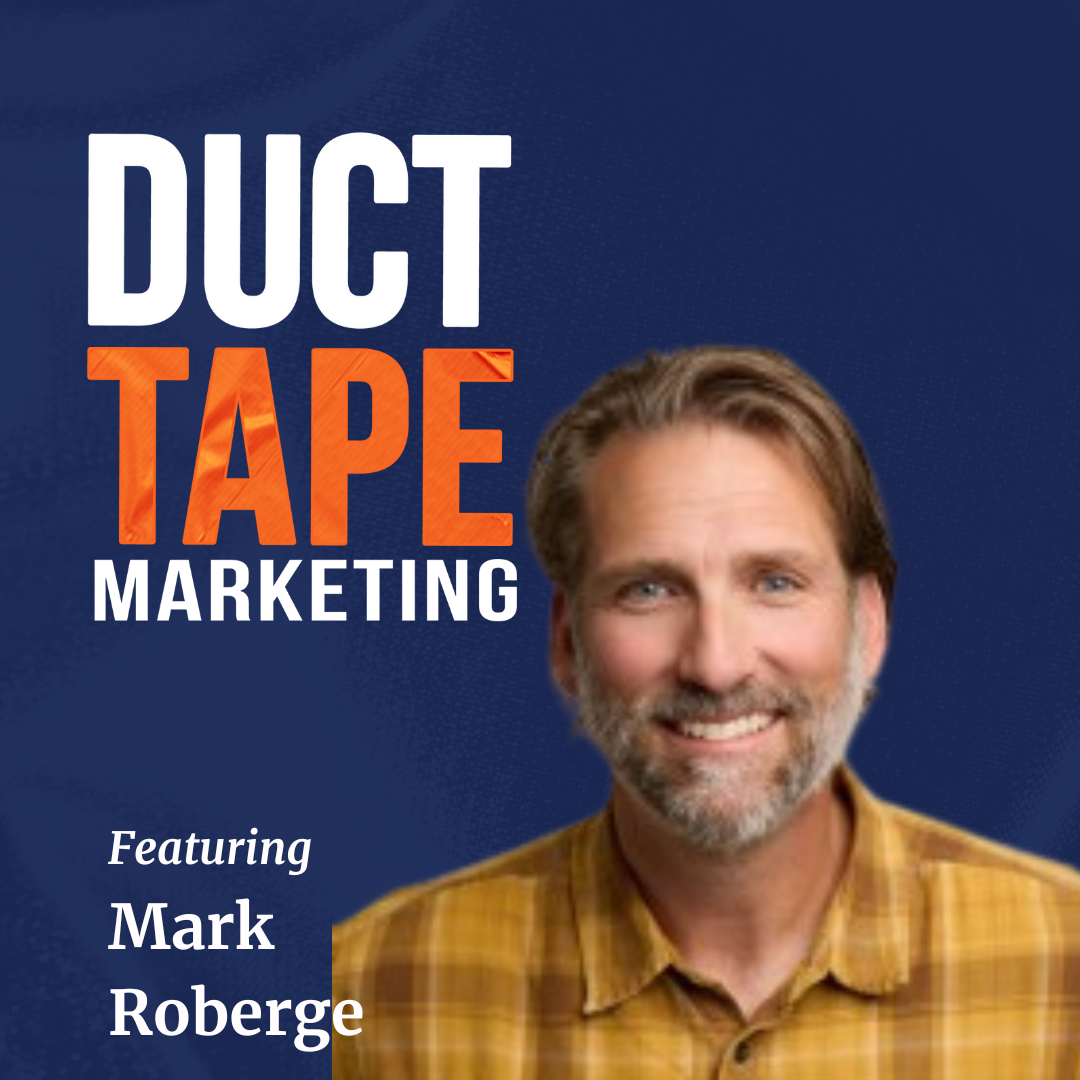
How to Know When Your Business Is Ready to Scale written by John Jantsch read more at Duct Tape Marketing
Catch the Full Episode
Overview
Scaling too fast kills companies. So does scaling too slow. But most business owners never stop to ask whether they have actually earned the right to scale at all. In this episode of the Duct Tape Marketing Podcast, John Jantsch sits down with Mark Roberge, co-founder of Stage 2 Capital, founding CRO of HubSpot, and author of The Science of Scaling, to unpack one of the most misunderstood decisions in business growth.
Mark helped take HubSpot from zero to IPO, then spent years at Harvard Business School teaching founders why so many fast-growing companies implode. His framework asks a different question: instead of “how fast can we grow,” ask “have we proven we deserve to grow?” The answer requires evidence, not instinct, and not pressure from investors.
This episode is for small business owners, agency owners, and entrepreneurs who are thinking about adding headcount, launching new channels, or entering a new stage of growth. If you want to scale without destroying what you built, this conversation is your roadmap.
Guest Bio
Mark Roberge is the co-founder of Stage 2 Capital and the founding Chief Revenue Officer at HubSpot, where he grew the company from zero to IPO. He later joined Harvard Business School as a senior lecturer, teaching founders and operators how to scale with discipline. He is the author of The Sales Acceleration Formula and The Science of Scaling, and has spent the past decade as an investor, board member, and advisor helping companies navigate the gap between early traction and sustainable growth.
Key Takeaways
- Product-market fit is not a revenue number. It is a retention metric. If customers are not staying and using your product, you do not have it yet, regardless of how many you have signed.
- Go-to-market fit is the second gate before scaling. It is measured by unit economics, specifically whether you can acquire and serve customers profitably.
- Scaling revenue too fast is a structural problem, not a motivation problem. Hiring 27 reps when you only have one requires 270 qualified interview screens, management infrastructure, and demand generation that most companies simply do not have.
- Build a monthly hiring pace instead of a January 2nd headcount dump. Steady, intentional growth gives you time to build the systems that support each new hire.
- The CRM funnel should not end at closed-won. Retention, engagement, and expansion are stages, not afterthoughts. The Marketing Hourglass is the right model.
- Leading indicators of retention can be defined simply. Slack tracked whether 80% of customers sent 2,000 team messages per month. You do not need a data science team to build a version of this for your business.
- A feature is not a moat. If a competitor can replicate your advantage in six months, it is not long-term defensibility. Founders need a vision for what makes them unbeatable over time.
- The ability to up-level the executive team around you as the company grows is one of the strongest predictors of a successful exit. It is also one of the hardest skills to develop.
- Sometimes the business outgrows the founder. The COO or president model is not failure. It is graduation. The reframe: someone else does the work you hate so you can focus on the work you love.
- AI is accelerating faster than society can adapt. Mark is donating book proceeds to McLean Hospital for mental health research, because the people building this technology have a responsibility to help manage its consequences.
Great Moments (Timestamps)
[00:02] — The opening question that reframes every growth decision: are you betting on a business that is not prepared to win?
[04:04] — Mark defines what it actually means to earn the right to scale, and why most founders get this wrong from the start
[06:25] — The two-step framework: product-market fit and go-to-market fit explained clearly
[09:51] — Half scale too fast, half too slow. Mark explains the Groupon and WeWork examples as two failure modes
[11:40] — How to measure product-market fit without a data science team, using Slack and HubSpot as real examples
[13:29] — John and Mark align on why retention and advocacy belong inside the customer journey, not outside it
[16:31] — Why a feature is not a moat, and what long-term defensibility actually requires
[17:43] — The London School of Economics study on what predicts a strong startup exit (the answer will surprise most founders)
[20:33] — The mental health connection: Mark shares why he is donating proceeds to McLean Hospital and what the AI era demands of technologists
Memorable Quotes
“The decision on when to scale is usually when someone hands you a fat check, which doesn’t sound that strategic.” — Mark Roberge
“Do not let the dashboards and sales funnels in your CRM end at closed-won. That is literally step four of seven.” — Mark Roberge
“A feature is not long-term defensibility. If your competitor can build it in six months, you don’t have a moat.” — Mark Roberge
“We’re basically offering to pay for someone to do all the work you hate so you can do the work you love.” — Mark Roberge on helping founders let go
“We as technicians need to diversify our efforts away from just building and profiting toward helping society adapt to this new world.” — Mark Roberge
John Jantsch (00:02.19)
So what if every time you hired too fast, launched a new channel or added a service line, you were making a bet that your business actually wasn't prepared to win. Hello and welcome to another episode of the Duck Tape Marketing Podcast. This is John Jance and my guest today is Mark Roberge. He's the co-founder of Stage Two Capital, founding chief revenue officer at HubSpot and the author of a book we're going to talk about today, The Science of Scaling.
Mark helped grow HubSpot from zero to IPO and then brought what he had learned into Harvard Business School where he taught founders how to grow without blowing up what they built. His framework gives business owners a way to use evidence rather than instinct or outside pressure to decide when they've truly earned the right to scale. So Mark, welcome to the show.
Mark Roberge (00:53.259)
Thanks, John. That's not my copy and I love it. Seriously, I love how you put it.
John Jantsch (00:59.105)
Awesome. good. Well, you know, we were talking before we got started, you and I met some 20 years ago when HubSpot was a nascent business. think maybe the first conference there were 500 people, something of that neighborhood.
Mark Roberge (01:04.916)
Yeah.
Mark Roberge (01:11.393)
Yeah, I was like in a Marriott in Cambridge. I have like, I remember specifically a couple of things about you. I think you were the most famous one of our early partners. I think I remember my last in-person chat with you was in some steakhouse in like South Boston or something. Cause I remember two people came up to you and asked for your autograph and you were like super humble about it. And I'm like, oh my gosh, this is crazy.
John Jantsch (01:21.271)
Ha ha ha!
John Jantsch (01:27.438)
You
John Jantsch (01:35.288)
Well, I'm glad I wasn't a jerk. That's for sure. Awesome. Well, let's get into your book a little bit. So I mentioned HubSpot, Harvard, now you back companies as a VC. Did something you learned or showed up across all three of those roles kind of make you say, I need to write this book?
Mark Roberge (01:37.365)
Hahaha
Mark Roberge (01:54.207)
Yeah. Yeah. It's like, it's kind of funny that we can unpack as much as you want, but in reflecting the last 20 years of my life professionally, I've given up on having a plan because I never intended to go into sales. I never applied for HubSpot. I never applied or intended to be a professor at Harvard. I never intended to start a venture capital firm.
And I never intended to write either the sales acceleration formula 12 years ago or the scientist's killing last year. These were all things that like people were like, would you be willing to do this? So they did, they do just like show up and the way that this one, as both books unfolded was a, like you, I am blessed with the opportunity to do a number of keynotes every year. and I, for the big ones like saster, I tended to try to do something fairly original for the year.
So I've, you every year I do something original. So I've given like 20 to 25 brand new speeches over the last decade. And this one was just like a pattern I saw after like eight years of being out of HubSpot as an independent board member, as a professor, as an advisor, as an investor, in why companies, the few that went IPO and billion dollar valuations versus the ones that went bankrupt was just this.
really non-strategic, non-rigorous perspective on when to scale and how fast. And half do it too early, too fast. Half of them wait too long and go too slow. It's more about going the optimal time. I started speaking about it and I'm like, it's ridiculous how many classes and rigorous frameworks we have on accounting for and accruing revenue, but not on scaling revenue. And it just went viral and kept speaking about it, kept writing about it. And then Stanford was like, hey, can you write this up?
And here we have it.
John Jantsch (03:47.128)
So the term, you kind of alluded to it, but I'll say it directly, earn the right to scale. It does a lot of work in your framework and your talk. So what does a business owner actually have to prove or do to prove that's true? Like, when do they know I have the right to scale?
Mark Roberge (04:04.286)
Yeah, it's kind of interesting how it unfolds right now. I I've done this with like tractor companies in Brazil and pharmaceutical companies in Japan, but mostly with software companies in Silicon Valley. And it's kind of funny how it's decided. Like the decision on when to scale is usually when someone hands you a fat check, which doesn't sound that strategic.
And so I try to unpack it as two steps that are sequential. One is product market fit and the other is go to market fit. And usually you're like product market fit, like duh, product market fit, duh. But like, what is product market fit? You know, I think a lot of people will say I'm ready to scale when I have product market fit, which I think is a great answer. But then when I ask them what product market fit is,
I get a lot of different answers, most of which are about a certain revenue number, a certain customer number, a certain number of inbound leads. And then I'm like, well, okay, cool. Let's say that you have 200 customers or like 500 inbound leads and everyone's buying, but like people stop using the product. Do you have product market fit? And they're like, okay, no, but
I'll just start, I'll just listen to them and build the product to appease their needs. And I'll be like, okay, well, how will you know when you've achieved it? And they'll be like, when they keep using the product and don't churn. And I'm like, exactly. So like that, that's like the first kind of like pivot mentally for folks is I encourage you to define product market fit, not as a revenue acquisition.
metric, but as a revenue and customer retention metric. And the book talks about how to extract that long-term lagging indicator back to something that you can evaluate in the first week of a customer being with you. Okay, so that's step one, product market fit. And then if you think about it, once you've achieved product market fit, all that means is that when you sign up 10 more customers, they're gonna see value that you promised and stick around.
John Jantsch (06:00.866)
Yes.
Mark Roberge (06:25.372)
It doesn't mean that you've proven that you can acquire and serve them profitably. And that's what go-to-market fit is. And it's measured by UNEconomics. So that's really the, probably the simplest way to describe the work is these two sequences of product market fit and go-to-market fit as measured by retention in the first one and positive UNEconomics in the second.
John Jantsch (06:29.506)
Mm-hmm.
John Jantsch (06:46.018)
Well, since we're defining terms, we probably better step back because I bet you if I asked 100 people, 10 people, 100 people sounds like too much work. If I asked 10 people what the word scale means, we'd probably get a bunch of definitions, more leads, more staff, more tools, but how do you define it?
Mark Roberge (06:59.21)
Sure. Sure.
Mark Roberge (07:07.528)
Yeah. So once you are ready to scale the way and that to your point, yeah, that can mean a lot of things. It could mean how do we scale our culture? How do we scale our engineering team? How do we scale our office space? Blah, blah. First off, I'm, I should be more clear that I'm talking about scaling the revenue. And to your point, scaling revenue, the inputs to that vary quite a bit by business by business. if you're a consumer business, you may just have to spend more on marketing. Something that you know a lot about Joan. if you're a B2B.
John Jantsch (07:15.094)
Mm-hmm.
John Jantsch (07:21.92)
Okay.
Mark Roberge (07:37.513)
sometimes you have to scale fancy outside salespeople if you're selling like rockets to governments. And sometimes you do it through PLG. And again, it's more of like a marketing exercise. So I really talk about scaling the revenue and the principles, apply, whether you're doing it through pure marketing or through, through sales head count. let's for simplicity, let's just talk about scaling through sales head count and the
Big pothole that people make there is even if they follow the guidance of like, let's achieve product market fit first and then go to market fit, and it could take a day, it could take a week, it could take a month, it could take a year, whatever, and now we're ready to scale, they raise money and then they have a target for the year and they hire like 27 reps the next week.
even though they only have one on the team today. And there's just no appreciation of the new capabilities that are needed to hire and onboard and manage 27 reps. Like just like, let's take one piece of it, which is let's kind of pontificate that the hiring quality might be correlated to the number of interview screens we do, qualified interview screens to the hire. If I do,
two interview screens and make a hire, I'm probably not gonna make as good of a hire as if I did 10 interview screens and make a hire. So if we're trying to do 10 and we're making 27 hires, that's 270 qualified interview screens. Where are we getting those candidates? Who's doing the interviews? Nevermind, where's the demand gen gonna come from? Who's gonna ramp them? What about the managers? It's just too driven from a Google Sheet or Excel, and so the simple pivot philosophically is,
Don't think about it as putting the annual plan together and hiring all those reps on January 2nd. Think about it as establishing a hiring pace every month or every quarter. 10 reps a month, boom, boom, boom. As opposed to like 37 at the beginning of the year.
John Jantsch (09:51.791)
So there's all kinds of horror stories of companies that blew up because they grew too fast. Would you say that they scaled too fast or they didn't scale fast enough?
Mark Roberge (09:57.47)
Yes.
Mark Roberge (10:04.928)
Both. have, like I said, it's about half and half. I mean, I would say like the classic examples out there, like an old school one is Groupon, which I think if you look at it from this lens, never really had product market fit. they just like, the promise was like, if you're a Chinese restaurant and give these coupons away, you'll get new customers, but it was really just the existing customers. And then maybe like WeWork never really had go-to-market fit. And that was pretty famously documented story.
John Jantsch (10:21.486)
There's Buzz. There's Buzz.
Mark Roberge (10:35.36)
The ones that didn't scale fast enough, we just don't know, right? Cause they're like, I can name some in our portfolio or people I've worked with over the years, but the reason why we don't know them is cause they just sat there and they were like, they had something, but the co-founders just like wanted to just go too slow and continue to do founder selling and wanted to run a profitable business when it needed to be a blitz scale business. And there's nothing wrong with running a profitable business. just, if you're trying to win in the AI customer support,
John Jantsch (10:38.702)
Yeah, yeah.
Mark Roberge (11:05.258)
category today, you can't be profitable right now. Like there's just certain blitz scale risk that you have in your category that needs to dictate how fast or slow you go.
John Jantsch (11:06.638)
Yeah.
John Jantsch (11:16.056)
So one of the key elements in science of scaling is evidence over instinct. So if I don't have a giant data team, and I know AI is actually solving some of this right now, but what does evidence actually look like at a startup or smaller business level?
Mark Roberge (11:29.768)
Mm-hmm. Yes.
Mark Roberge (11:40.117)
Yeah, I mean, you don't, you definitely don't need like a sophisticated data science team. You don't even need AI agents doing this stuff. Let me just give you like a really simple example. So we talked about product market fit is where I'm, I'm proposing to everyone that it's more about customer value and retention as opposed to customer acquisition. And obviously you need to acquire customers to eventually make them valuable. So it's an input to it.
John Jantsch (11:48.526)
Okay, all right.
Mark Roberge (12:08.34)
The retention is a lagging indicator. So we needed to find a leading indicator of retention. We can't wait a year to know if we have product market fit. I need to know like the week after I acquired the customer or the month after. And so what the book and the work I've been doing with companies for last decade is to help them define their leading indicator of retention. What is it that we can observe in the first month of a customer's experience with you, your product, your service, whatever.
that if we see that, they'll be with you forever. And if we don't, they'll probably churn. And so like, I frame it as P percent of customers do e-event every tee time. Okay, so that sounds like the programmers on the audience are like loving this right now. The history majors are like totally lost, right? So like, just to bring that to life, Slack, 80 % of customers send 2000 team messages every month. HubSpot, 80 % of customers use five or more features in the platform every month, right?
John Jantsch (12:53.55)
You
Mark Roberge (13:08.564)
These are things that can be measured in the first month to give us insight. If we're at 80%, we probably have product market fit. If we have 10%, we definitely don't. I don't need a data scientist to evaluate that. Okay, so these are not overly complicated, like PhD math type things.
John Jantsch (13:20.174)
So.
John Jantsch (13:29.922)
One of the things I've been preaching for 20 years is that when we talk about the customer journey, that retention and advocacy and all the things that come after somebody becomes a customer are part of the customer journey or should be part of the customer journey. And for so many people, it's let's get a customer. And I think what you're really certainly hammering home here is this idea that you're not going to scale without retention and without
Mark Roberge (13:44.234)
Yes!
John Jantsch (13:59.382)
know, referrals or whatever you call it. Yeah.
Mark Roberge (14:01.984)
Spot on. mean, when I hear people like you say this, the conviction continues to escalate, right? Because it's like, another way to say what John is saying here is, let's just talk really tactically. Do not let the dashboards and sales funnels in your CRM end at closed one. That is like literally step four of seven, right? Like let's just like really step back, like very, very like basic, like.
John Jantsch (14:20.468)
Yeah.
Mark Roberge (14:31.654)
know, opportunity stage one is, you know, business, like discovery call and like business and you know, metrics definition. Step two is product validation, demo, blah, blah. Step three is closed one. Step four is set up. Step five is regular engagement. Step six is retention. That's the funnel.
John Jantsch (14:52.558)
He
John Jantsch (14:59.438)
Yeah, yeah, yeah, yeah. I actually refer to it, have been referring to it as the hourglass, you know, with the idea being that, the funnel, right, but then it goes back out again. Yeah. Yeah.
Mark Roberge (15:06.26)
Totally. And expands. Exactly, because you expand more and like lot of people like winning by design with Jaco and like that's just a great way, the bow tie. A lot of people like it's a really good way to think about it because that usage, it represents that the usage and should grow.
John Jantsch (15:16.589)
Yeah.
John Jantsch (15:23.576)
So you were at Harvard and name a dozen schools, Stanford, that a lot of people go to those because they've got a big idea or they wanna have a big idea. They wanna turn out the next Google. I'm sure you encountered many founders or would be founders in those environments. What would you like if you were, I'm sure you did this in your class environment.
tell them they're gonna get wrong or how would you coach them of how you think they're thinking about it incorrectly?
Mark Roberge (15:58.009)
I mean, there's a lot to that. I think we covered a lot of them related to the work in terms of like, you know, being more precise around having the business fundamentals in place to be prepared to scale and how you go about scaling. I would say,
I guess I'll add two more to it that come up a lot, one that's related to revenue development to some degree and one that it really isn't. The one I'll mention is having a plan for a moat. And I would say like, when I ask people what their long-term defensibility will be, they often tell me about a feature.
John Jantsch (16:31.992)
Yes.
Mark Roberge (16:45.468)
And when I asked them if they are correct and they start crushing it and start winning, and then the competition realizes it, how long will it take them for them to build that feature? And they say six months. And I say, that's not long-term defensibility. So, so you really have to like, you don't have to prove it on day one. Cause oftentimes it might take something that you have to kind of take one of those design big start small approaches to it.
John Jantsch (17:02.58)
Hehehehe
Mark Roberge (17:14.464)
but you really need to have a vision around if you are right, there will be lots of copycats and the incumbents will try to take you out and you need to make sure that you win there. The other one, unless you want to talk about that, John, I have one more that I can throw out that's pretty popular. Yeah, yeah, the other one that's interesting, I think it was a study done at London School of Economics where they looked at like, I don't know, 5,000 seed funded businesses like 15 years ago and.
John Jantsch (17:22.637)
Yeah.
Yeah.
John Jantsch (17:31.17)
Yeah, yeah, go for it.
Mark Roberge (17:43.282)
and tried to evaluate the commonalities for those that like exited at, you know, very strong exit. The number one correlation was the founder's ability to up level the executive team around them as they went through the various phases of growth. And it's like, it's so pronounced in my journey with some of these folks. It's like, it's so hard to do too. Like it's so hard for like a founder to like stare someone in the eyes who've been there in the trenches with them from day one for three years.
and be able to communicate that they are over their head and that the business needs someone ready for the next stage. How you deliver that, how you recognize it, how you have the guts to say it, how you like move through that and still feel like a human and still feel like that person has been made whole. Like that's such a difficult skill to build, but that there's so much correlation with successful founders and CEOs and in
developing and executing that skill.
John Jantsch (18:43.372)
Well, and let's take it up one level. Many times the business outgrows the founder, right? So they may be having that conversation with themselves, right? Yeah.
Mark Roberge (18:48.714)
Sure. It's very rare that they're there. Totally. Yeah. And that lots of times the board has to manage that. think we, we went from an, like a culture or like a tactic around that. would say in the eighties and nineties when venture capital was much smaller and startups were, it just, was a much smaller portion of the economy. VCs were notorious for investing in these young technicians and then
fire in them. And I think in the early 2000s, venture took a different approach. They didn't want to get a reputation for firing CEOs. So they did what I call the Sheryl Sandberg, which is to like bring in the, the operator, but keep the CEO, which is good. think that's great. think a lot of times that CEO can sort of graduate up to being a
face to the organization, a driver of the culture, a person to be in key meetings with customers, to be on the road, but like don't have to be or nor qualified to be like the day-to-day operators, hence like today's COO president role. So, but yeah, sometimes founders, they're like not willing to let go. And I have to be like, I have to be like, do you even understand that you have graduated to an era and scale that every CEO
John Jantsch (20:00.782)
Yes, yes.
Mark Roberge (20:15.519)
founder dreams of, we're basically offering to pay for someone to do all the work that you hate and have you just do the work you love, which is product vision, talking to customers and talking to the market. So it's like, it takes a little reframing, you know.
John Jantsch (20:17.56)
Yeah, that's right.
John Jantsch (20:23.598)
You
John Jantsch (20:33.16)
Yeah, yeah, yeah, yeah. So you, I think your PR people mentioned this, they're donating the proceeds to the book to McLean Hospital for Mental Health Research. Is there an intentional connection of the subject of scaling to mental health?
Mark Roberge (20:42.014)
Yeah.
Mark Roberge (20:48.113)
my gosh. Huge. Well, not so much. It's very light. It's more of an intentional connection to the author. and it's just something as you've experienced, John, it like you get up, you get up in the morning and do these things three times more aggressively when you have a cause like this around you. And there's two personal reasons and thank you for providing a platform to talk about them. The first one is mental health has played an enormous piece in my own life.
John Jantsch (20:55.992)
Yeah.
Mark Roberge (21:18.259)
I have been a caregiver, a direct caregiver to many loved ones and I've been a patient. And I can stand here and say this because I've been blessed with certain resume wins that society values and I can be braver than most. And I'm sure by saying that some people may be hesitant to work with me. And I just think we need to fight that stigma more. Like we've come a long way in a generation, but
Even to this day, I think a lot of people will be interviewing a candidate and find out they survived cancer 10 years ago and it will elevate their perception of them versus if they found out that they overcame a serious mental illness, they may have some concern and both are just a disease. They're often genetic. So that's part of the personal driver. And the second one is I think in this moment in tech, there's a hundred times more capital talent.
John Jantsch (22:02.03)
Yes.
John Jantsch (22:07.308)
Yes.
Mark Roberge (22:17.009)
an effort going into building AI and next to nothing in helping society adapt to the world that about to become. And I think we as technicians need to change that. We can't delegate this to Washington or economists. They're just not close enough to it. And we just need to like really diversify our efforts away from just building and profiting toward
John Jantsch (22:25.347)
Yes.
Mark Roberge (22:44.265)
helping society adapt to this new world. like with every tech revolution, we ended up better as a society, but there are scars along the way. It happened with the internet. They're about to be really bad with AI if we don't do anything. So I think we all need to find a little thing to do. And right now that's my little thing to do.
John Jantsch (22:51.734)
Yes.
John Jantsch (22:59.914)
Awesome. Well, I appreciate you taking a few moments to stop by the Duct Tape Marketing Podcast. Any way you'd invite people to connect with you, find out more about your work as well as your latest book.
Mark Roberge (23:11.315)
Yeah, I'm all over. mean, LinkedIn is probably where I'm most at. I'm trying to hang out on TikTok more, John, just to like, because I need to like talk to these 22 year old founders as well, which is awesome. So I'm trying to find where they are. But I'm mostly on LinkedIn if folks want to go on there and collaborate.
John Jantsch (23:25.55)
Well again, I appreciate you stopping by and hopefully we'll run into you someday in a steakhouse in South Boston. I don't know how much that'll be worth to you, if you got a pen, I'll do it. All right. Thanks, Mark.
Mark Roberge (23:32.305)
I'd love it and maybe I'll ask for your autograph, John.
Mark Roberge (23:42.578)
All right, it's great to see you. Thank you.
Sign up to receive email updates
Enter your name and email address below and I'll send you periodic updates about the podcast.
from Duct Tape Marketing https://ift.tt/B0jIhOq
via IFTTT

Overview
Overview