Monday, January 8, 2024

How to Scale Your Agency with Productized Marketing Services

How to Scale Your Agency with Productized Marketing Services written by John Jantsch read more at Duct Tape Marketing

The best thing you can do right now to scale your agency is to productized marketing services.

Struggling to scale your strategic marketing agency? Working tirelessly on both big and small projects but feeling like your earnings don’t match your effort? This frustration is shared by many, where the hours poured into work seem to overshadow the financial return. I navigated a similar hurdle when I first started my strategic marketing agency, Duct Tape Marketing, working relentlessly but watching my earnings plateau. It was at that moment I understood things couldn’t stay the same.

Over 20 years ago, I pivoted from tailoring bespoke, effort-heavy marketing solutions that left me exhausted and my clients less than impressed to embracing a transformative strategy: productized offerings. productized marketing services. This strategy was a game-changer, allowing my agency to work smarter, not harder, and significantly increasing our revenue year after year.

Get a complete fractional CMO system that changes how you think about your agency’s growth.


Table Of Contents:

The Essence of Productized Services in Marketing

Productized marketing services are fixed, repeatable offerings; most agencies offer services tailored to each clients’ unique needs. This is not to say that each client is not unique and should not be treated as such. But in the very beginning of an agency-client relationship there are certain things that every client needs and that is what can be productized.

The idea of productizing marketing service based business goes beyond marketing and can really be applied to almost any service-based industry.

Defining Productized Marketing Services

In marketing, productizing means turning your offerings into standardized packages. Like products on a shelf, these services have fixed scopes and price tags. Think Facebook ads or web design but sold like off-the-rack suits: they fit well enough for most businesses without needing tailor-made solutions.

This business model takes what typically might be custom work—say designing a website—and distills it down into something more tangible: “Website Design Package A includes up to 5 pages with basic SEO optimization.” It makes buying decisions easier because clients know exactly what they’re getting and at what cost—a powerful lure for small businesses watching every penny.

Benefits of Productizing Your Agency’s Services

If you’ve ever faced cash flow headaches at month-end or juggled multiple client expectations simultaneously, standardization could be your ticket to scalability heaven. By defining precise deliverables upfront—whether it’s logo design or web development—you let potential clients know exactly what they’re getting without any guesswork involved.

Productizing also allows agency owners to save time focusing on crafting high-quality content rather than being bogged down by project management intricacies every step along the way. You get more space to stay focused on market trends while fostering long-term relationships through reliable delivery mechanisms; ultimately leading not just revenue growth but also customer satisfaction due largely thanks in part because user experiences have been made so much better.

Revolutionize your agency with productized services—like a 3 item coffee shop menu for digital marketing. Say hello to clear choices, fixed prices, and happy clients. #MarketingStrategy #AgencyGrowthClick To Tweet

Crafting Your Productized Marketing Service Offerings

Turning your marketing agency’s services into well-oiled machines starts with a focus on productization. Creating a consistent experience for your customers through productizing is the key to providing an efficient and expert service.

Identifying Your Target Market

Before anything else, zeroing in on who will love your service is key. You want to aim for that sweet spot where 20% of customers bring in most business benefits—your ideal target market. Look at your data trends; they don’t lie. They tell tales of who your best clients and who’s willing to pay for the value you provide.

Once you have identified the top percent then dig deeper. You need to understand their pain points better than they do themselves because let’s face it, everyone loves someone who gets them.

Structuring Your Service Packages – Standardize

The art here lies not just in creating attractive bundles but ensuring each one has clear deliverables—a transparent blueprint clients can trust. With clarity comes confidence from both sides: agencies promise tangible results while clients grasp exactly what they’re investing in.

Pricing structures mustn’t be a puzzle either; transparency wins races here too. By communicating pricing models early, clearly, and often you can start to earn trust, something that is hard to do in the agency world.

Standard Operating Procedures (SOPs) for Consistency

SOPs aren’t glamorous—but boy do they pack a punch when delivering consistent customer experiences. This step will take time. Even if it took 3 weeks, it would likely be the most beneficial 3 weeks you spent on one thing for you agency.

This structured approach helps teams stay focused so time isn’t wasted reinventing wheels but rather polishing those already rolling smoothly along tracks paved by streamlined processes designed specifically around efficiency—and ultimately leading towards predictable outcomes loved by all parties involved.

These SOPs are what will allow you to scale, to teach others how to run your processes almost as well as you would. This is what will allow you to start working on your agency instead of in it.

Key Takeaway: Turn your agency’s services into productized services, offering the same excellence every time—like a trusted cup of coffee.

Nail down who really digs your service. Use data to uncover their pain points and craft packages that hit home – For Them, Not You.

Create clear, confidence-boosting service bundles with straightforward pricing. And finally experience a trusted client relationship.

SOPs are your secret sauce for delivering spot-on customer experiences consistently—it’s all about precision and predictability.

More on the Benefits of Productizing Your Marketing Services

It’s about transforming those time-sucking, custom, often unpredictable service offerings into neatly packaged, expert solutions that clients can trust. Because you have done it before you know what the results will be. Your services are proven and not a test.

Streamlining Sales and Operations

By standardizing your offerings with productized services, you create a smooth-running machine. Your client knows the exact service that they will get with clear package outlines and pricing and you know exactly how to deliver that to them and how much time it will take.

Your team members will thank you as well because when they have clear standard operating procedures (SOPs) to follow, it takes away guesswork and streamlines training. And if there’s one thing employees appreciate, it’s knowing exactly what needs to be done without having to decode cryptic instructions every day.

Boosting Profit Margins

Once you’ve nailed down an efficient delivery method for your productized service—the kind that lets customers know precisely what they’re getting—you can actually charge more for them. Yes indeed. Because consistency breeds quality which justifies premium pricing all day long.

This model also helps keep cash flow steady since recurring services mean predictable monthly income streams—it’s like subscription models in retail but without needing fancy box packaging or catchy jingles.

Enhancing Customer Value Proposition

Last but certainly not least is how this approach elevates customer experience—a critical factor considering today’s consumer savviness where poor user experiences never go unnoticed (or so social media would have us believe). When clients understand exactly what they’ll get from each package offer—they’re happier because transparency builds trust.

The cherry on top? They start seeing results quicker thanks again to those standardized processes which make delivering high-quality work efficiently.

Key Takeaway: Productizing your marketing services turns chaos into clarity, making sales smoother and boosting profits. Your team gets clear SOPs while clients enjoy transparent packages they can trust—leading to quicker results and killer referrals.

Communicating Value Effectively

Sell not just what it is but what it solves; paint a picture where their life gets easier because of your packaged solution—and yes, we mean literally spell out those benefits so they know exactly what they’re signing up for.

  • Your Facebook ads management might save 10 hours per week—that’s binge-watching two seasons of “The Office” worth of time saved.
  • Show them how speed optimization means no more spinning wheels on their website—which translates into visitors sticking around longer than a confused squirrel on a busy street.

Remember though—no amount of persuasive chatter will stick if you don’t deliver promised results. That said, once people see others singing praises about how much easier life is post-adoption (cue testimonials.), trust me—they’ll line up faster than kids at an ice cream truck.

Examples of Productized Marketing Services


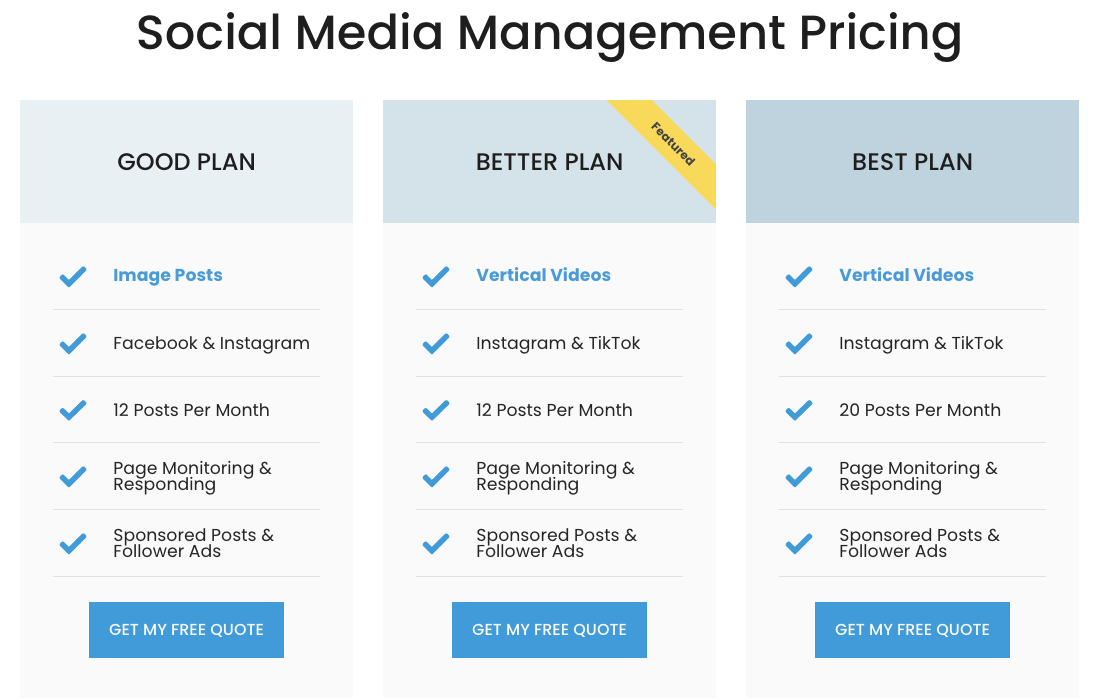
  • Social Media Management: Create tiered packages for managing different aspects of social media. These could range from basic content creation and scheduling to comprehensive management, including strategy development, analytics, and engagement across multiple platforms. Here is an example of Lyfe’s social media management’s packaged service. Tired packaged service plan for Social media managementSEO Optimization: Develop bundles tailored for different levels of SEO needs. Services could include keyword research, on-page optimization, technical SEO audits, content strategy for SEO, and backlink building strategies.
  • Content Creation: Offer monthly subscription plans for creating various types of content. Depending on the package, this could include blog posts, articles, video scripts, and infographics, with different volumes and frequencies of content production.
  • Email Marketing: Provide structured packages for designing and managing email marketing campaigns. This can include newsletter design, list segmentation, campaign automation, and performance analysis to optimize engagement and conversions.
  • Marketing Strategy and Consulting Packages: My personal favorite and expertise. Offer a comprehensive package that includes market analysis, strategy development, and implementation guidance. This could involve competitor analysis, identifying target demographics, developing marketing strategies tailored to the client’s business, and providing ongoing consulting services for strategy refinement and execution. At Duct Tape Marketing we offer this in just one inclusive and expertly crafted package through our Fractional CMO+ System.
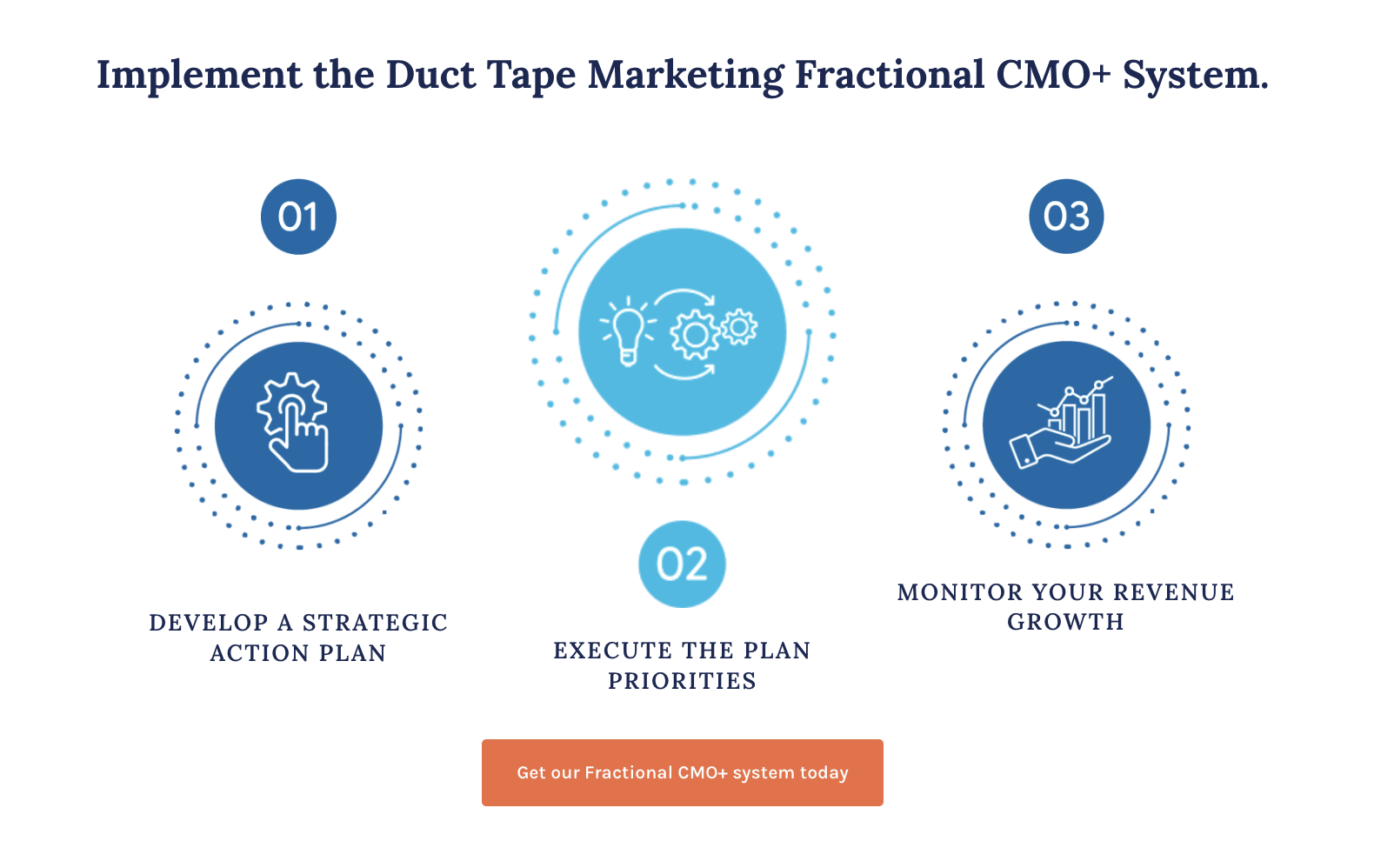
Duct Tape Marketing Fractional CMO+ System

Marketing Your Productized Services Effectively

Give Your Productized Service a Name

Name or brand your service to help sell it. For example, I created Strategy First, which is the name for my marketing system that I offer to clients. That itself became it’s own brand. I created materials, elements, and graphics just for Strategy First. This showed my clients exactly what they were going to get and familiarize themselves with the concept.
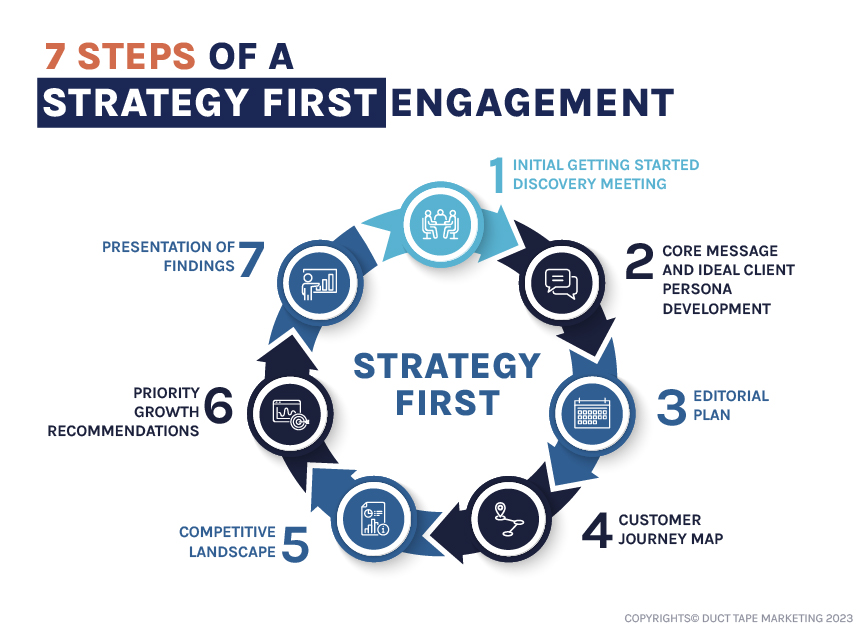
The steps of Duct Tape Marketings Strategy First Marketing System

Leveraging Social Media and Content Creation

According to a survey by Databox 47% of agencies are not happy with their self-marketing when compared to their competitors. Social media isn’t just for cat videos anymore—it’s a megaphone for your marketing message. Educate your audience on the problems that this productized approach solves for them and use social media to amplify that message. Craft high-quality content around pain points, showing them there’s light at the end of their problem-riddled tunnel through your well-defined service packages.

Field Testing and Refinement

Rome wasn’t built in a day—and neither will perfect productized service models be conjured up overnight either. Once you’ve created some stellar packages based on your best-selling services it’s showtime: field testing with actual paying customers who’ll give honest feedback. This stage is crucial since customer insights help tweak those initial assumptions made during development.

Key Takeaway: Market your productized services: Give your productized service a brand, name and voice.


Build trust through content. Use social media for more than just posts; tell stories that resonate with your audience’s challenges and spotlight how your services are their light at the end of the tunnel.

Leverage SEO to make sure those searching for what you offer find you first—optimize content, clarify deliverables, and use internal linking to drive conversions.

Test & refine.

Embrace productized marketing services, and you transform chaos into clarity. Embrace standardization, and you give your clients the gift of certainty. Embrace scalability, and watch your business grow.

Finding that sweet spot in pricing models takes finesse but gets you closer to predictable cash flow and agency expansion. Crafting these services means tuning into your top clients, taking the time to standardize, and locking down SOPs—because consistency is king.

Your marketing strategy and expert-level productized services should make you the trusted advisor in your clients eyes. Ultimately, enhancing customer experience through clear deliverables that secure trust and those long-term relationships crucial for sustained success for any strategic marketing agency.


Free up your time, increase ROI, and finally learn how to scale by licensing a complete fractional CMO+ system for your marketing agency. We have helped 1000s of agencies scale and clients soar with this proven marketing system, check it out.


from Duct Tape Marketing https://ift.tt/PcdnuJg
via IFTTT

Saturday, January 6, 2024

Weekend Favs January 6

Weekend Favs January 6 written by John Jantsch read more at Duct Tape Marketing

My weekend blog post routine includes posting links to a handful of tools or great content I ran across during the week.

I don’t go into depth about the finds, but I encourage you to check them out if they sound interesting. The photo in the post is a favorite for the week from an online source or one I took on the road.

  • Peasy – Peasy is a comprehensive solution tailored for businesses focusing on Online to Offline sales. Recognizing that not every product fits the standard e-commerce model, Peasy bridges the gap between online lead generation and offline sales closures. This platform assists in generating high-quality leads, managing sales teams, and tracking deals effectively, all within a single, integrated system. It’s designed to enhance the efficiency of the sales process, from the initial online engagement to the final offline transaction, making it an essential tool for businesses seeking to optimize their appointment-driven sales strategies.
  • Taplio – Taplio is the ultimate all-in-one LinkedIn tool designed to elevate your personal brand and streamline your content creation. It harnesses the power of AI to help you generate ideas, improve, and even automatically create customized posts and carousels. Taplio’s advanced features include personalized post generation, a personal chat assistant for content ideation and completion, and the ability to create LinkedIn carousels from any URL or topic. With access to over 5 million viral posts for inspiration and user-friendly scheduling features, Taplio ensures your LinkedIn presence is consistent and impactful.
  • Timely – Timely is an AI-powered automatic time tracker designed to streamline time management. It automates the entire time tracking process, allowing you and your team to dedicate more focus and energy to the work that truly matters. By eliminating the manual effort typically involved in logging hours, Timely ensures accuracy and efficiency in tracking time spent on various tasks and projects. This innovative tool is essential for businesses looking to optimize productivity and gain deeper insights into how their time is allocated, all while minimizing administrative burdens.

These are my weekend favs; I would love to hear about some of yours – Tweet me @ducttape

If you want to check out more Weekend Favs you can find them here.


from Duct Tape Marketing https://ift.tt/6DY2w5X
via IFTTT

Thursday, January 4, 2024

From Subscribers to Revenue: A Tactical Guide To Mastering Newsletters

From Subscribers to Revenue: A Tactical Guide To Mastering Newsletters written by John Jantsch read more at Duct Tape Marketing

The Duct Tape Marketing Podcast with John Jantsch

In this episode of the Duct Tape Marketing Podcast, I interviewed Russell Henneberry, a renowned digital marketing consultant, speaker, and the founder of The Clikk newsletter. Our deep dive into the world of email newsletters unveils tactical strategies for transforming subscribers into revenue-generating assets.

Russell shares invaluable insights on the resurgence of email newsletters. As the founder of The Clikk, Russell has witnessed the evolving landscape of newsletters, recognizing them as a powerful intersection of content marketing and direct response promotion.

In this eye-opening discussion, Russell mentions the significance of email newsletters as a prime platform for making direct calls to action. Highlighting the importance of engagement derived from content marketing, he guides us through the balance of providing valuable content while seamlessly integrating strategic calls to action.

Key Takeaways:

Russell Henneberry provides the tactical strategies to transform subscribers into revenue. Discover the resurgence of email newsletters as a dynamic tool for content marketing and direct response promotion. Russell emphasizes the art of crafting engaging content with a purpose, seamlessly balancing information, inspiration, and entertainment. Dive into the approach of nurturing subscribers towards meaningful engagement and strategic calls to action. Uncover diversified monetization strategies, including advertising, consulting, and info products, ensuring a sustainable and profitable newsletter business. Learn crucial metrics for success, from open rates to the quality of subscribers. Russell Henneberry provides a roadmap for mastering newsletters, offering insights to elevate your digital marketing strategy and turn subscribers into a valuable revenue stream.

Questions I ask Russell Henneberry:

[01:51] How have you seen newsletters evolve over the years?

[03:40] Do you believe putting newsletters behind pay walls will have sustainable longevity?

[04:53] What’s your editorial strategy to getting and keeping subscribers?

[06:15] Would you agree that a key approach in Newsletter writing is having a voice?

[09:34] Has a Newsletter writing career always been part of the plan or was it just another digital marketing tactic for you?

[11:18] What is your approach to monetizing?

[15:09] What are some of the metrics that showcase success in Newsletter writing?

[17:17] What approach might you recommend to somebody to build a list?

[20:36] Do you feel like you have a different relationship as an advertiser because of the relationship with your readers??

[21:34] Has AI impacted your thoughts on producing content?

[25:26] Where do you want to invite people to connect with you?


More About Russell Henneberry:

Get Your Free AI Prompts To Build A Marketing Strategy:


Like this show? Click on over and give us a review on iTunes, please!

Connect with John Jantsch on LinkedIn


This episode of The Duct Tape Marketing Podcast is brought to you by ActiveCampaign

Try ActiveCampaign free for 14 days with our special offer. Sign up for a 15% discount on annual plans until Dec 31, 2023. Exclusive to new customers—upgrade and grow your business with ActiveCampaign today!


John (00:52): Hello and welcome to another episode of the Duct Tape Marketing Podcast. This is John Jantsch. My guest today is Russell Henneberry. He is a digital marketing consultant, speaker and co-author of Digital Marketing for Dummies. He's the founder of the clikk an email newsletter about digital marketing. Russell also consults and trains employees of companies through his digital advisor program. So Russ, thanks and welcome to the show.

Russell (01:20): Hey, thanks for having me on.

John (01:22): It's an honor. So do you go by Russell or Russ or Depends on who you're talking to.

Russell (01:26): It doesn't matter, but most people call me Russ, but Russ.

John (01:29): Okay. There are

Russell (01:30): Several people.

John (01:30): I just jumped right into it. Alright. I mentioned that you have a successful newsletter called The Click, so I thought we'd talk about newsletters. Newsletters have been around for ages. I've been putting one out at least for 20 years myself. How have, and I know that you've studied, we are alluding to some of the old timers before we got on the air here, how have you seen newsletters evolve? Because I think they were in sort of phase one of digital marketing. They were kind of a standard tool, but then social media came along and other stuff came along. They fell out of favor. Now they seem to be really back in favor. What do you see happening in the space in general?

Russell (02:10): Well, what I see right now is a return to email newsletters. They're hot right now, and I think of email as this intersection of content marketing and sort of direct response promotion. Email is still a great place to make and probably the best place to make a direct call to action, which is sort of frowned upon most of the time in social. But when you can take the email and turn it into content so you're not just continuously pounding your email list with promotions, you can get this sort of best of both worlds where you get that engagement that you get from content marketing plus the bonus big bonus of being able to make direct calls to action.

John (02:58): Yeah, I mean I started mine to share, educate, build, trust, all those things. But let's face it, it was a way to build an email list. I literally remember people 20 years ago saying, oh, I got your newsletter. I'm so excited. I that was before we got tons and tons of email every day. So in terms of how, I mean I think I look at your newsletter, I subscribe to your newsletter and it is pretty classic format in terms of education. There's not any new crazy technology necessarily that's showcased there, but I know it works. I mean, just looking at some of your statistics, I know it works for you, but before we go into that, LinkedIn has newsletters now there are people putting newsletters behind paywalls. Do you see those as approaches that will be with us for a long time because it's very curated content or do you think the classic approach that you take is still valid today, obviously?

Russell (04:00): Yeah, absolutely. And I've looked at moving my newsletter over to things like substack or moving into LinkedIn and publishing there. Personally, I want to be able to control that technology because I want to be able to do some other things with it, and I'm not afraid to mess around with that technology. But I think the barrier to entry into starting a newsletter because of things like substack and then the competitor, their beehive is also something to look at. If you're looking at starting a newsletter, the guy who I believe was in charge of list growth at Marketing Brew or Morning Brew started beehive. So there's some really great out of the box options there. I like to have more control over everything, so I end up with sort of that patchwork of tools. But yeah, I mean, getting into the newsletter business is easier than ever today.

John (04:51): Yeah, so getting subscribers is one piece of it, but then keeping them, because it's worth reading is obviously a huge part of this. What's your editorial strategy? I'm curious, how do you decide? I'm sure you don't wake up on Monday and go, here's what I'm going to write about.

Russell (05:11): Yeah, well, so the content marketing side of the editorial strategy, I'm always in all the top of funnel content and sort of mid funnel content that I produce. I'm looking to either educate, inspire, or entertain, and I do try to get a little bit witty inside of there, and I have some editors that do a pretty good job of helping me not tell too many dad jokes in there. But yeah, I mean my goal when I talk to my editors when I think about my own stuff is that I want to give you something educational, but I want to do it with a spoonful of sugar and that's that entertainment don't take myself too seriously angle. I think we see a lot of that because competing against other publishers like say Digiday or Adage or something like that, that are probably a little bit more buttoned up. And so if you like my style, then you're going to read my stuff and you're going to anticipate my stuff coming into your inbox.

John (06:12): So you didn't say it as directly to this, but I mean I think certainly a best practice would be have a voice of some sort that's going to either repel people or attract people.

Russell (06:23): Right. Yeah, I think a good way to think about this is an exercise you can do when you're looking for a voice is you can say to yourself, I want to be the blank of blank. So if you know what niche that you're in, let's say you're going to be creating a gardening newsletter, you might say, I want to be the

John (06:43): Seinfeld of gardening newsletter,

Russell (06:45): Jerry Seinfeld of gardening or whatever, of gardening. And that can help you start to box out what maybe you're looking for from a voice perspective.

John (06:53): Yeah. What would Jerry say? So you threw out the terms top of funnel, middle of the funnel. Maybe explain how you differentiate your content based on maybe where somebody is in a potential buying situation.

Russell (07:08): Yeah. Well, and we were talking about this before you hit record. We were talking about newsletters are a great way to build trust and they're a great way to connect with people. You're right there in their inbox and you do that consistently over time. You're going to build that know and trust, but it's still making a really high ticket offer. It's tough to do in an email. So I'm typically looking to get people to engage with my content and then I'm going to ask them to do, so. For example, last week I ran an article and then I said, if you'd like me to shoot you a little video to expand on this and show you some examples, click this link and I'll tag you in my system or whatever. And so then I shot a Loom video and I sent that out just to people that were tagged and had asked for it. And then inside that video, I make a call to action for a service or a product or a horse or whatever that I'm looking to do, but I only want to do that with people that are really engaged strongest parts of my list. It's sort of that whole, don't ask somebody to marry you on the first date type thing. Where we want to kind of build up that know and trust with people over time.

John (08:20): And you make a great point because I think a lot of people they have, you just said a high ticket item, let's guess at a price $9,700 thing. And the idea that somebody's going to read a newsletter mean if they've been following you for years, they've decided time's, right? But the idea that somebody's going to click on a button and buy something like that, it really needs to be much more of a dance to get their, doesn't it?

Russell (08:42): For sure. Whenever I'm talking to anybody in my consulting work about what they're selling, I try to immediately put it in one of two buckets. I'm putting it in, I can close this deal on a webpage bucket or I put it in, I got to get this person on the phone bucket. And if it's a phone bucket, which if you're hitting that 10 K mark, that's phone bucket for me, you're going to need to get somebody on the phone. There's going to need to be a sales process and so forth. You might be able to close that online depending, but probably not. And so those kinds of calls to action are difficult to make in a newsletter. And so what I like to do with that is you're trying to nurture people towards a phone consultation, and that takes a lot of touch points

John (09:27): Unless you over promise something you can't actually deliver.

Russell (09:32): There's always that.

John (09:34): So we're waiting into monetization. How do you think, actually, let me back up before I ask that question. I want to ask a broader question. Was there a point in time where you said, I'm going to go all in on newsletter, this is how it's going to fit my business model? Or did it start more as, yeah, this is a normal standard digital marketing tactic?

Russell (09:56): So I kind of did go all in. So we are email first. So I like to think when I'm thinking content marketing, I think about where's the genesis of this content going to be? And I think podcast, by the way, are a wonderful place to create original content and that's where it's born. And then you can hand that out to writers, for example, and have them chop that up into pieces and go out to social with it and cut the video up and different things like that. And my newsletter is that for me, so I produce original content only there in that newsletter, and then that stuff is then chopped up and cut up and put into different places. So the reason I did that is because I was spending a lot of time thinking, well, how am I going to get this person from social media onto my email list and how am I going to get this person from listening to this over here?

(10:43): And I'm from this YouTube video and from my website, and I said, well, why don't I just start there? Why don't I just start with them on the email list and focus all the attention there and then I can move them out from there. So just like you could do with a podcast, just like you could do with a YouTube channel is just where are you producing that original material? And then you can then kind go and do what you want with it from there. And a lot of times you can hire somebody to go do a lot of it from there.

John (11:10): So again, now as I alluded to monetization, maybe I'll just let you much as you're comfortable sharing about all the ways you think about monetizing, and I know there are some very direct ways that you do it, but I'd love to hear your theory on that.

Russell (11:27): Well, I like to keep it diversified because things go up and down. So for example, I sell advertising and it's very easy to sell advertising in the fourth quarter because everybody's fleeing Facebook and Google for cheaper clicks elsewhere because of all the retail ads are cranking up prices and things like that. For me, advertising can be kind of seasonal. So I also sell trainings and courses. I use it to fill my consulting work. If I need a consulting client, I'm going to start working towards that through that list. And so yeah, it's advertising, it's consulting, and some info products like courses and so forth.

John (12:14): So if I'm a potential advertiser, I'm guessing top of funnel ads, like list building ads, give away a great resource ebook, lead magnet kind of ads are really what work in a newsletter like yours. They,

Russell (12:28): I think it's, when I speak to advertisers, I advise them to try to move people from my list onto theirs because people that are reading my newsletter have shown that they use email as a source of information. So it's smart for them, in my opinion, to use a lead magnet offer or a webinar offer or something like that can move them into that person's email list because that person is an email reader. But we do get a lot of advertisers that know we want to go straight for free trial or we want to go straight into an offer or something like that. And we'll do that too, but absolutely love the, and we see great response from people that give out a solid high value lead magnet to my list.

John (14:57): Let's talk about metrics. Again, going back to when I started, I remember 83, 80 4% open rates. Those days don't exist for anybody today, but what are some of the metrics that, not just that you should be tracking, but that show you're doing things right?

Russell (15:18): Well, so when you start to get involved in buying traffic to get subscribers, it becomes pretty important that you're buying subscribers that are opening because especially if you're selling ads, because think about it, you might be measuring, for example, your cost per lead and it might be let's say at a satisfactory $4 per lead, but then you're finding that these leads are only opening at 30%. Well, are they really only $4 leads when you're only getting three out of 10 to open? So it really is important to be watching the quality of the subscribers that you're getting and whether they're opening, and it might be worth paying six or $8 for a subscriber that will open. And so I do love the idea when you're running a newsletter of advertising and other newsletters, because again, that person's shown the propensity to read newsletters and use email as a source of information. So yeah, I mean, it's the classic ones. Open rates, click rates, cost per lead if you're buying traffic. I also look at sort of the virality. How can I take any subscriber that maybe I've bought right at $4, $6 or whatever and turn that into 1.5 subscribers so I can get them to spread the word and get me. And that cuts. If I can get one every one person to bring somebody else, then I cuts my lead costs in half. And there's some cool tools out there that can be used to do that

John (16:48): Referral tool. Yeah,

Russell (16:51): Up viral is a cool one that works really well to get people to share and using a unique link and then you can reward them with more content, things like that.

John (17:02): Let's talk about list building then. Obviously a lot of your success, a lot of your ability to sell ads, a lot of your ability to have reach is that you're getting subscribers. So what's kind of your approach or what approach might you recommend to somebody to build a list?

Russell (17:21): Well, so when I started out, I said I want to build a list that advertisers will find attractive. So that's kind of where my brain started. So that comes down to your ad targeting that you're going to use when you buy traffic. So I was looking to build a list of people that are doing marketing work for other people. So they're either agency workers or freelancers, because software companies and service companies oftentimes find these people very valuable, A software company especially where they can roll, if they can get an agency to adopt their tool and roll it to all their clients, that's a big client for them. So we set out to build that list and that's on this list, and it's all comes down to your targeting. And that particular subscriber might cost you more. You might be able to go find other people that would want to read the same content for cheaper, but is that what your advertisers want? And I think if you're going to sell advertising, you need to be thinking about building a valuable list, not just any old list.

John (18:26): Yeah, yeah, yeah, absolutely. Well, and also if the diversification you want to sell to that list, they should be people that are obviously interested in what you're selling. So you do recommend buying subscribers, so to speak, or buying at least traffic that you hope to turn into subscribers?

Russell (18:43): Yeah, I mean, if you want to advertise, I think you need to hit that 10 K subscriber mark before they start getting interested. You got to remember that you're dealing with advertisers that could just go into Facebook and access a limitless, nearly limitless group of people. So there's an unlimited scale, in other words, inside these other platforms. And so you got to have at least some scale in order for them to take a look. So I do like the idea if you've got your advertising packages in place and you're able to do it, but I don't recommend that you start there. So with advertisers, your monetization model, I would encourage people to, especially if you're just getting started to sell services or information products, until you can get to that because you're going to want to, unless you're funded and you've got a giant dumpster of cash that you want to burn, you're probably going to need to be r oi if you're buying traffic and you need to be r oi it a little bit faster. And so you can't just sit here and build up until you hit 10 K and then start selling advertising. So I would recommend that you sell either even physical products, but physical products or info products or services until you hit that 10 K mark. Then you can add that, start adding in that advertising revenue.

John (20:00): So over the years, I actually sell sponsorships. It's just kind of a package with our podcast and things like that. But I've always felt like, well, now I have a personal relationship with my subscribers. They really see it as me, and a lot of that is on the trust that I don't try to shove stupid stuff down their throat. So do you sometimes find yourself really having to, we've turned away sponsors because we're like, no, and I mean, they're obvious ones, but even sometimes where we just don't feel like that's a very good tool or a very good resource, we'll say No. So do you feel like you have a different relationship as an advertiser because of the relationship with your readers?

Russell (20:43): Well, I turn people down all the time, and it's because it's just, I'm the end decision maker on all that. But I can see how larger publications must have a battle between editorial and monetization, right? Because you do get people that want to just put your stuff in front and you could just take their money and put it in front of people. But I know that's not the good long-term strategy for my business, is not to just shove things on their throat. And I can always, if I don't have an ad to run that, I just run my own stuff. This is sponsored by this course or this whatever, this event that I'm going to or whatever.

John (21:22): Yeah. All right. So I'm going to end on the question that we could have spent the whole time talking about, but I've been throwing this into pretty much any conversation, especially about content, but ai, how has that impacted your thoughts about producing content?

Russell (21:42): Well, obviously things are shifting daily with this, so check the date on this podcast because it depends. But what I'm seeing now is every tool that I use is overlaying on top of chat GPT. And so I am using AI every day. The way I use it for content creation is typically for things that would've maybe taken me a half hour. For example, I, I won't go into why, but I needed to have the details of Dwight Eisenhower's career for a little article I was writing, and I just popped it into chat, GPTI was like, give me a bulleted list of Dwight, and it was done. And because it wasn't completely crucial, that was even correct, a hundred percent, I just popped it in there. I didn't even check the information. It all looked pretty, right. So I popped it in there, and if somebody would've come back and said, actually, he didn't start the highway program or something, he did this, I would've been like, well, that wasn't really the point of the article, but I'm using it for stuff like that.

(22:50): I do come down on the side right now that if you are, you're not creating content that's better than what CHATT PT can put out. You shouldn't be creating content. You're probably not getting any traction anyway. It does lack voice now. I mean, you can get some pretty incredible stuff out of it, but still, in fact, at the top of my newsletter, what I've been doing, just to be sort of cheeky, is today I just finished it up and I said, this newsletter was written by a human with real arms and legs and everything. And I do see a world where it's going to have value for you to state that you've chosen to continue to write or produce your content yourself. I think there'll be other places where people are going to be tolerant of what, I don't care if that's a bot that wrote that, or a person, but other places where we are going to find a lot of value in the fact that someone is writing this is a real human with experiences and memories and thoughts and all those things.

John (23:52): Yeah. Well, I've definitely am telling people that if you can't ignore it or you won't be able to compete, but we're definitely a long way. In fact, I don't even think it's artificial intelligence. I've been kind of jokingly switching it around and calling it ia. It's informed automation is what I really think it is. And just as your example, I mean, imagine if you were trying to come up with a killer headline and you had three or four people sitting around and you all brainstormed it. Well, that's the way that I use Chad GPT is, it's like, make this headline better. Give me 10 ideas. And it's like, there might be one word that I go, yes, that's the word, but that's really how I use it almost as a research assistant.

Russell (24:31): Yeah, I mean, it's open on my desktop right now, and I can't see myself going away from using it anytime soon. It's here to stay, so it can't be ignored. But you and I have both been doing this a long time, so we've seen people try to take things like this and look for a shortcut built. I'm sure there's people building giant content filled websites with AI content in them, and I've been doing it long enough to know that in the long run, it's not going to be a sustainable business model.

John (25:05): Well, and what I love is the Make Seven Figures as an AI consultant courses that are being sold right now, too.

Russell (25:13): Yeah, they're everywhere,

John (25:16): But such is life. Right. Well, Russ, thanks so much for dropping by and kind of sharing some of your knowledge on the newsletter. The Click we'll have how to subscribe in the show notes, but certainly anywhere you want to invite people to connect with you,

Russell (25:31): Well, yeah, just come over to the newsletter, the click, CLIK k.com and the subscribe and say hello. You can always reply. I read all the replies to my emails, and then if you want to connect me on social media, I'm Russ Henneberry on LinkedIn.

John (25:46): Awesome. Well, again, thanks for taking a moment out of your day to share with our listeners, and hopefully we'll run into you one of these days out there on the road.

Russell (25:53): Yeah, it's been my pleasure. Thank you.


from Duct Tape Marketing https://ift.tt/6YPvAHM
via IFTTT

Wednesday, January 3, 2024

Embracing Slow

Embracing Slow written by John Jantsch read more at Duct Tape Marketing

It’s become pretty popular, almost trendy, for people to choose a word at the beginning of the year and make the word the focus or underpinning of their most important objectives.

My friends Chris Brogan and Ryan Holiday have done this and written about it for years.

I’ve been practicing informally for a few years, so today, I’m letting the world know that my word for 2024 is – Slow.

In a world where the pace of life, change, and business accelerates yearly, adopting the theme of ‘slow’ for the year might seem counter. Yet, I think that it’s precisely this shift in mindset that can lead me to discover more profound, impactful results in my personal and entrepreneurial endeavors. See, the idea isn’t to do less but to be more present and intentional in everything I do.

Slowing Down in Everyday Life

The word mindfulness is tossed around so much that it’s become passe because everyone gets it and agrees with the notion, but dang, is it tough to do.

My daily routines are often a blur of activities, with little time for reflection or appreciation. Slowing down means taking the time to actually taste my morning coffee, really listening to the birds chirping outside my window, and feeling the texture of the paper as I journal in the morning. It’s the stupid stuff: chew your food, stop talking so much, hike slowly, and listen. We all talk about gratitude being the secret weapon, but it’s not just about saying thank you for what went well today – slow cultivates gratitude in, well, everything.

Quality Over Quantity

I hope my ‘slow’ role will open up deeper connections in relationships. Foster more meaningful conversations rather than brief exchanges. Maybe the phone has no place in slow intention. Can a slow Zoom mentality allow me to focus entirely on the person speaking, understanding their perspective fully?

Strategic and Thoughtful Actions

For the entrepreneurial me, ‘slow’ doesn’t mean less progress; rather, it’s about strategic and thoughtful action. Do less but do it better, more focused. Something like the difference between a well-researched, personalized pitch and a generic, mass email blast.

The ‘Slow’ Day

One way I plan to implement this is to designate one day each week as a ‘slow’ day. I’ve been doing this for a few years from a strategic planning viewpoint but not so much from a personal development view. On this day, I will consciously remove the rush. Initiate practices that are all about mindful awareness. Schedule no meetings, but build a few relationships. Spend longer on tasks, appreciating the process. My slow days will allow my fast days to feel far more productive.

I guess I share all of this because, for some, it might resonate; for others, I hope you’ll see it as an invitation to hold me accountable in ways that matter.


from Duct Tape Marketing https://ift.tt/3k2lwYI
via IFTTT

Walking Billboards and QR Codes: Revolutionize Your Sales Strategy

Walking Billboards and QR Codes: Revolutionize Your Sales Strategy written by John Jantsch read more at Duct Tape Marketing

The Duct Tape Marketing Podcast with John Jantsch

In this episode of the Duct Tape Marketing Podcast, I interviewed Amanda Holmes, CEO of Chet Holmes International, and a maestro in the realm of sales strategy. We dived into the fascinating world of unconventional marketing tactics and the transformative power of the Dream 100 strategy.

In this eye-opening discussion, Amanda Holmes, a trailblazer in sales strategy, reveals the unconventional yet highly effective methods she employed to revolutionize the sales game. As the CEO of Chet Holmes International, Amanda inherited a multimillion-dollar enterprise and doubled its sales by 1176% in the first year.

Holmes emphasizes the significance of the Dream 100 strategy, a potent approach that originated from her father’s work with billionaire Charlie Munger. By targeting a select group of high-value prospects, Amanda explains how this strategy, rooted in old-school principles, became the fastest and least expensive way to double sales for numerous companies.

Amanda’s unorthodox approach at trade shows involves walking around with a four-foot billboard strapped to her back. Discover how this attention-grabbing tactic, combined with strategically placed QR codes, became a powerful offline-to-online conversion tool. Uncover the secrets behind Amanda’s ability to create a buzz, capture attention, and convert leads seamlessly across different mediums.

Key Takeaways:

In this episode:

  • Learn how in-person engagement, coupled with digital elements like QR codes, can significantly enhance your sales strategy.
  • Explore the impact of unconventional marketing tactics, such as walking billboards, in creating brand awareness and generating leads.
  • Understand the synergy between offline and online efforts, and how blending traditional and modern strategies can revolutionize your sales approach.

Amanda Holmes takes you on a journey into the heart of revolutionary sales strategy. From the Dream 100 concept to walking billboards and QR codes, uncover the tactics that propelled her success in doubling sales and transforming businesses. Embrace the fusion of old-school principles with modern marketing techniques, and revolutionize your sales strategy for unparalleled success in the digital age.

Questions I ask Amanda Holmes:

[03:02] As a family member, what was it like being thrust into an ongoing organization?

[06:13] In turning things around, what was the hardest thing for you to change?

[08:14] What’s been the most enjoyable part for you?

[09:43] Has your background in music brought a level of creativity to the organization that did not exist before?

[13:19] Who’s your typical client?

[14:43] Describe the concept of the ‘Dream 100’?

[19:30] Would you say in some ways older processes are working better than ever?

[21:28] Where can people connect with you and obtain a copy of your book?


More About Amanda Holmes:

Get Your Free AI Prompts To Build A Marketing Strategy:


Like this show? Click on over and give us a review on iTunes, please!

Connect with John Jantsch on LinkedIn


This episode of The Duct Tape Marketing Podcast is brought to you by ActiveCampaign

Try ActiveCampaign free for 14 days with our special offer. Sign up for a 15% discount on annual plans until Dec 31, 2023. Exclusive to new customers—upgrade and grow your business with ActiveCampaign today!


Speaker 1 (00:57): Hello, and welcome to another episode of the Duct Tape Marketing Podcast. This is John Jantsch. My guest today is Amanda Holmes. She is the CEO of Chet Holmes International, which is worked with over 250,000 businesses worldwide. At age 24. She inherited her father's multimillion dollar enterprise, which specializes in helping companies double their sales. A lot of their work's based on the bestselling book, the Ultimate Sales Machine, of which they have a new edition coming out. Amanda's name will be all over the new edition as well. And she has merged her father's proven process with her own forward-thinking Ideas to connect the old school sales process with hybrid, online and offline, instant gratification and short attention span that we see in consumers today. So Amanda, welcome back to the show.

Speaker 2 (01:47): Thank you so much, John. It means so much to me that you interviewed my father and then you interviewed me so many years ago, and here we are again. It means a lot. Not a lot of people interviewed my father either.

Speaker 1 (02:00): I was going to say, I might be one of the few podcasters who has interviewed you both.

Speaker 2 (02:06): Yes, I have never heard it from anybody else, and I've done hundreds of interviews, so you are the only one.

Speaker 1 (02:12): That's funny. That was about 29, 20 0 9, 20 10, something like that maybe. And podcasting was in its infancy at the time, but somehow I've stuck with it.

(02:24): So we also have another shared connection. My daughter has actually worked for me for about 12 years. She is our chief operating officer, so I really kind of have to go there. You didn't work in the business as a family member, you really brought, came into the business. I would have to think in some ways that was a pretty tall order. In fact, I think you were studying music in college and not necessarily preparing for a career as a CEO. Right. I guess I was going to ask you what's like working with family, but that's not really, it wasn't really your experience. So what was it like really? And I know you've told this story many times, what was it like basically being thrust into an ongoing organization, but as a family member?

Speaker 2 (03:11): Yes. Well, it was hard because me and my father were very close. I was actually born on his birthday. We shared the same birthday February 13th, and it was as if just the stars aligned. And so losing him was like losing air. It was like I didn't know where up was or down was. I couldn't eat. I couldn't sleep. So getting all of that while at the same time, I can remember just days after his funeral. And the only reason why I remember that, because all that time is such a blur, but I just remember all of these flowers around my room from his funeral, and I was sitting there and they had just sent me the PL of all the companies, and it was the first time I'd ever seen it, and it just felt like this p and l was never ending. I kept scrolling and scrolling and I just broke down.

(04:01): I was like, how is this possible that, so my father battled with cancer for a year and a half before he passed, and he spent 352 nights in the hospital, and never once did he spend it alone. So it was me, my mom, and my brother. We rotated spending all nighters with him. So I spent easily a hundred all-nighters with my father in the hospital. Never once did he say, Hey, Amanda, let me explain to you what my businesses are. Let me explain to you who runs them. Let me tell you about where I'd like this to go. We never had that dialogue, and there was time, and I speak on that because I think it's critical that more parents take responsibility for the fact that there are other people that if you leave this world without a plan, you're hindering them. So I do talk on that every once in a while.

(04:57): So it was utterly shocking and it really is. I look back and I think it's a miracle that we're here today based on the fact that I knew nothing. I was trying to get over the loss of my father while couple hundred staff, this crazy enterprise, but here we are. I stepped in and it took me two years to step in because it just looked like, this is crazy talk. I don't know why I ever would. But then over time I fell in love with our clients. I recognized that there was something that was really beautiful about what my father had built, and it could be carried on. It just needed that heart in the center of it to make it all work. And yeah, I increased our leads by 1176% the first year I stepped in and doubled our coaching clients multiple years in a row, and this year we're up over 300%, and that's without the book releasing just yet. So it's a lot of wonderful things. My father had a great system and a great framework for how to grow organizations, and I had to learn it from his books and his training programs instead of him explaining it to me. But nonetheless, I think I am probably one of his greatest success stories just because of that. Right.

Speaker 1 (06:13): What was hard for you? I mean, you obviously made some changes. What was hard for you to change? I mean, not necessarily resistance, but just really hard for you to even wrap your head around changing.

Speaker 2 (06:27): So we had never processed an order online. My father was very strict around every sale should come from a salesperson having a conversation either over the phone or in person. So I could remember the first time that I put some pricing online and I took a moment and it was like, I'm so sorry, dad. I know you said this, but times have changed and I have to do it. I have to put some of our stuff online. So that was a big turning point in learning how to do digital marketing was critical in selling things online. And then also a huge change was for me, the people that I surround myself with, a lot of them were very different than who my father surrounded himself with. So I find that the culture that he thrived in is different than the culture that I thrive in and making that distinction, because at first it was anybody that my father respected, ultimately they would say, well, your father said I was the best in the planet on this.

(07:30): And I'd go, okay. And I'd put them up on this pedestal of who was the best, right? Because my father said he was the best, even though I started realizing that everyone said that my father said they were the best. So then I started reading through his emails to try and figure out what he really thought of them. That was the way that I would find out. And then the next level was okay, just because my father said he was the best, now I have to discern, is this somebody that I can work with? And there were quite a few of them that did not work with me very well. And that's okay. It's just a little bit of a different modus operandi, but still the strategies are the same. So it was interesting to see that culture shift.

Speaker 1 (08:10): So shifting gears a little bit to maybe a more positive, less of a challenge, what's been the most fun for you?

Speaker 2 (08:17): The marketing and sales part. Oh my gosh. Oh, you'll appreciate this, John. So I just, I'm in this whole book tour thing going on right now. I just went to all these different trade shows. I spoke at HubSpot's inbound. That's where I saw that you're in HubSpot Network. Congratulations on that. That's awesome. So I went there with a four foot billboard strapped to my back. I was looking for a way for people that my father teaches, the first thing you need in a trade show is to get noticed. And I was googling like, oh, maybe we'll do a backpack and we'll design a backpack or something. And then I found, I typed in human billboard and this huge thing, it's a backpack that straps and it lights up. It glows a billboard sign. So I've been walking through all these trade shows with this four foot billboard on my back. I call her Bessie now because I'm very fond of her. And on the last day of trafficking conversion, actually they shut me down because I was creating such a buzz and generating so many sales that the sponsors, the booths were getting jealous. But that's been a blast, and just being really creative about ways to get attention and then converting that attention into sales and leads and sales, that's a ton of fun for me.

Speaker 1 (09:39): Would you say that your, and I know this is going to sound sort of stereotypical, but would you say that your music background, your arts background, has brought a level of creativity that maybe didn't exist?

Speaker 2 (09:51): Absolutely. So the new addition of the book, the foreword, instead of saying, dear Reader, I instead said, dear dad. And that was something that Julia Neeson, my book coach at the time, had suggested I do. And when I wrote it, everyone that read that majority of grown men that read it would cry reading it, and they thought out of every page, every sentence, I made sure that it was some way to double sales. But that letter to my dad, everyone said, lead with that because that's going to touch more people than just doubling sales techniques. And I put that into a video, actually, and that's been what I've been using to promote the book. So to me, that video is a music video. I wrote the lyrics, even though I'm not singing them, they're written. But everything that I had as a songwriter, I put into that video. To me, that's the single that came out with this new edition of the book, which is kind of funny to think about, but man, it is hitting people in a completely different way that I never expected, and it was the most nerve wracking thing on the planet to put that thing out. I really thought that. I didn't think that people would like it, but everybody kept saying, I love it. I love it. You should put that out. And it's been such a loving response. So yeah, that songwriter in me, I think helped

Speaker 1 (11:16): Describe who CHI, Chad Holmes International works with. Who's your typical client?

Speaker 2 (11:22): Yes. Okay. I'll answer that by asking you a question, and you probably know the answer to this. What percentage of businesses do you think make it to a million in annual sales?

Speaker 1 (11:32): I don't know the exact answer other than it's relatively small. The numbers, yeah, you have to guess. I'm going to say 9%.

Speaker 2 (11:40): Okay, that's close. It's close. 5% of companies make it to a million of that 0.08%, make it to 5 million of that 1.5%, make it to 10 million so it gets a little bit better. Then 0.004%, make it to a hundred million and beyond. So what we teach is how to get from a million to five, from 5 million to 10, from 10 million to a hundred million and beyond, because it's actually not about our product or service, which majority of entrepreneurs think, yes, if I just tweak this a little bit more, then I'll get more. Right? If that was true, wouldn't be the number one grossing hamburger joint in the world. Right? It's a terrible burger skills it takes to grow the business and skills can be developed. So we assist entrepreneurs to grow from that one to five, from five to 10, from 10 to a hundred million and beyond.

Speaker 1 (12:34): One of the core concepts, I have actually not seen what you've done in the second edition yet, but certainly in the first edition, and I know it's a core concept of your coaching, is this concept of the Dream 100. I wonder if you could describe that. I know that's a big E for you.

Speaker 2 (12:49): Yes. It's the fastest, least expensive way to double sales. This one strategy has doubled the sales of more companies than any other. My father invented it working for billionaire, Charlie Munger, co-chairman of Berkshire Hathaway. So he doubled the sales of nine different companies for Charlie all within 12 to 15 months, and several of them multiple years consecutively. So he realized that he had a system for doubling sales, and it went something like this. So he was given a list of 2200 potential prospects, and they said, okay, go cold. Call these 2200. But when he did some research, he realized that only 167 of them purchased 95% of the space. So instead of going after 2200, he led an intensive Dream 100 to just those 167. Now, it being in their face, in their place, in their space, what can we do to provide the most value for them?

(13:41): For him, back then it was direct mail, cold calling and faxing. So twice a month, he was doing direct mail. Four times a month he was cold calling and following up with a fax in an email every once in a while. And he did that for months. For the first four months, he got nothing and talked around the office, what is this? Why is this expert in sales? And he hasn't generated a thing. But in the sixth month, he closed the largest contract that the industry had ever seen, and then subsequently after that doubled and doubled and doubled. Now. So by definition, there's always a smaller number of better buyers than there are all buyers. That means that marketing and selling to them is cheaper than marketing and selling to all buyers. And I've even, as I look at this, and what you'll see in the new edition is so many people get, they see the Dream 100 and they go, oh my gosh, how do I do direct mail?

(14:31): How can I make this work with direct mail? And how do I get a hundred people on my list? You're missing the point if you're super focused on just those two things, because we have so many marketing mediums in our use today, I show how I used a dream. One, I focused on one potential dream client, and I followed up with them every single day using social media. Every time they post something on social, I'd comment with something of value. Every time they posted another thing, I'd add another piece of value and another comment, and another, for every single day, for three months, I commented on every single thing that this person said, and three months in, they came back to me and said, Hey, I'd like to buy 650 books of the Ultimate Sales Machine. I'm still reaping the benefits of that three months of pigheaded discipline and determination.

(15:19): Today, they bought another thousand books. Actually, it was the CEO of ClickFunnels. So Dave Woodward I did this with. So the point is, it's about picking who's one person that could completely change your world, and then can you multiply that even by, you could have four, you could have 10. I'm calling it the Target 12. It doesn't have to be a hundred, right? The whole point is just to get laser focused and follow up with pigheaded discipline and determination, whichever medium that may be. If you want to use direct mail, that's great because it will land doing direct mail. But if you want to do it on Instagram dms, that's where I did it to get that client right. It could be on LinkedIn, it could be on voice drops, on cell phones, or

Speaker 1 (16:03): All of them. Or all of them. Or all of them, right?

Speaker 2 (16:06): Yeah. If you only have a hundred, right? And if you're doing Facebook ads to them, if you are sending them text messages, if you're arriving at their door, they're like, you are everywhere. It's like, yeah, I'm only everywhere to the select 10, select a hundred. So they're just amazed, right?

Speaker 1 (16:21): Yeah. And I think what's so important about that lesson is you can now afford to spend money and time and energy that is going to just swamp what anybody else is doing to that same person, because they're spraying it 10,000 people at a time.

Speaker 2 (16:39): Absolutely. We had a client, so I've created these bootcamps, and a client went through the bootcamp. They went after four people that had already said no to their services. It was a hard, no, I'm definitely not interested. And then he led with an education to those four. After he gave the presentation of an education, he closed $8.4 million worth of sales in just six weeks. Six weeks, and the average sales rep would sell 8 million in an entire year. He did it in six weeks. He targeted his dream. He only needed four, dream four to generate 8.4 million.

Speaker 1 (17:17): So one of the challenges, you kind of alluded to this, we're so focused on digital right now, you have yourselves firmly in what you're calling old school processes, but they really, in some ways, some of the old school processes are working better than ever. They

Speaker 2 (17:36): Absolutely, I mean, take what I just did at trade shows, it's shocking how many people at trade shows have no idea how to have a face-to-face conversation. I'd walk up to a booth and 90% of them had no idea how to start asking questions. I'd ask, what do you do? And they have no idea. They look starstruck. Like What? You're talking to me in real life? I don't know what to do. It's so bizarre how we've lost the frameworks and the basic foundational principles. Everyone thought, oh, a billboard. Yeah, that's brilliant. But then I also had a QR code there so that I could collect people that were taking pictures. Anyways, the first few days they were taking pictures of me. They thought it was hysterical, but then they didn't realize that now I'm converting them because they're clicking on that I'm getting their email, and then they're buying.

(18:25): So it's blending of the two. My funnel online got me the sales, but me walking around with a four foot billboard on my back in a trade show got the attention and the press, and now I've taken video that I got from influencers in the space that were recording me. They thought it was hilarious. And I'm using that in my ads and I'm repurposing it. So there's so many different ways that I think in person too. I was just at a mastermind with Grant Cardone two weeks ago, and there were 80 people in the room, all of which would've loved to talk to Grant Cardone. He walked out of the room and nobody followed him. And I'm looking around the room going, are you kidding me? That's a billionaire. I'd love to talk to Grant Cardone. Why not? So I run out there and I start to have a dialogue with him. It's as if we only can communicate through a text or in a social media aspect. He was right there live and breathing, and I handed him the book and I said, you should watch Dear Dad. It'll make you cry. I'll send you a book. And he's like, I will definitely cry from that. I'm sure I will. I love that. Thank you,

Speaker 1 (19:26): Amanda. Thanks for dropping by the Duct Tape Marketing Podcast. Tell people where they can find all the work that you're doing and certainly get a copy of the new book or the revised, updated, fully updated book.

Speaker 2 (19:37): Yes. Ultimate sales machine.com is where everybody can pick up the book. It'll give you a bunch of extra bonuses that you wouldn't get on Amazon. And then if you want to online, I'm a lot of different places, but I spend more of my time on Instagram. My name Amanda Holmes was taken, so I'd use my salsa name Manita Holmes, so you can find me on Instagram at Amanita

Speaker 1 (19:59): Homes. Alright, awesome. Well, great having you back on the show again, and hopefully we'll run into you again. One of these days out there on the road.


from Duct Tape Marketing https://ift.tt/d60WyM2
via IFTTT