Wednesday, March 12, 2025

The Truth About SEO, AI, and Content in 2025

The Truth About SEO, AI, and Content in 2025 written by John Jantsch read more at Duct Tape Marketing

The Duct Tape Marketing Podcast with Bruce Clay

In this episode of the Duct Tape Marketing Podcast, I interviewed Bruce Clay, widely regarded as the “Father of SEO.” With a career spanning nearly three decades, Bruce has witnessed every major shift in search engine optimization—from the early days of simple keyword ranking to today’s AI-driven landscape.

During our conversation, Bruce shared powerful insights into how Google ranking, AI-generated content, and SEO strategy are evolving in 2025. We discussed the impact of search engine algorithms, the role of content marketing, and why businesses must rethink their approach to website optimization and organic traffic.

SEO is changing fast, and Bruce Clay’s insights highlight why businesses must adapt or risk being left behind. Whether you’re an SEO consultant, marketer, or business owner, focusing on SEO strategy, usability, and high-quality content will be critical in 2025.

Key Takeaways:

  • Quality Over Quantity – Google now prioritizes on-page SEO and content marketing strategies that focus on user experience rather than sheer volume of content.

  • AI-Generated Content Needs a Human Touch – AI can create thousands of pages, but search engines favor SEO best practices that combine automation with human expertise.

  • Link Building is Still Relevant—But Different – Google ignores low-quality links, meaning only the highest-authority backlinks contribute to organic traffic and rankings.

  • SEO Success Depends on Usability – Factors like site navigation, search engine algorithms, and mobile-friendly design impact website optimization more than ever.

  • The Rise of AI Overviews – Google’s AI-generated answers are shifting how users interact with search results, making SEO consultants rethink search engine optimization strategies.

  • Brand Mentions Are More Valuable Than Ever – As AI prioritizes trusted sources, appearing in podcasts, guest blogs, and digital marketing discussions is key to staying relevant.

Chapters:

  • [00:09] Introducing Bruce Clay
  • [00:53] SEO in 1996
  • [04:47] The Growing Importance of SEO
  • [11:19] How to Create Quality Content for SEO
  • [14:50] Is Zero-Click the End of SEO?
  • [18:59] Guest Podcasting Can Help SEO

More About Bruce Clay: 

Check out Bruce Clay’s Website
Connect with Bruce Clay on LinkedIn

This episode of the Duct Tape Marketing Podcast is brought to you by

Want to elevate your marketing game? AdCritter pairs Connected TV ads with precise digital retargeting to drive real results. Discover how their full-funnel strategy can help your business grow smarter. Let them know Duct Tape Marketing sent you, and you’ll get a dollar-for-dollar match on your first campaign! Learn more at adcritter.com.

John Jantsch (00:01.26)

Hello and welcome to another episode of the Duct Tape Marketing Podcast. This is John Jantsch. My guest today is Bruce Clay. He is known professionally as the father of SEO. He's been a world renowned expert in the field of SEO since 1996. A lot of people couldn't spell SEO in 1996, probably, right? Bruce programmed the first webpage analysis tool. created the search engine relationship chart, which is earned

Bruce Clay (00:22.021)

.

John Jantsch (00:27.734)

over 300,000 or did earn over 300,000 downloads in its first month. He wrote and taught how to optimize websites to be found in search, establishing bruceclay.com as the trusted source for how-to information in the field of search engine optimization. So Bruce, welcome to the show.

Bruce Clay (00:46.083)

Thank you very much. Glad to be here.

John Jantsch (00:48.174)

So I would ask you to tell me about your history in involvement in SEO, but that would take the whole show probably, right? So let's just start with, what was kind of the kernel of SEO? Like 1996, a lot of people didn't have websites. So what did SEO look like when you first got started?

Bruce Clay (01:07.333)

Let me give you a little bit of background. My background is programming. You know, I have one of these degrees in math and computer science, but I also have an MBA. So I was looking for something that was marketing, but programming and a long-term search, which is an algorithm.

John Jantsch (01:16.302)

Mm.

Bruce Clay (01:32.823)

So that's what really attracted me to it in its entirety. I got in, programmed some stuff, came up with some of the first tools, and started doing optimization. I have a background in mainframe optimization, so I just moved it over and started optimizing web pages. And they were

John Jantsch (01:51.512)

Yeah, okay.

Bruce Clay (02:00.889)

You know, I was trying to become a consultant, right? And consultants name the company after them and they do consulting and that's what consultants do, right? And there weren't a lot of people that were really aware of the power of marketing online, but a lot of companies had websites. They were catching on.

John Jantsch (02:11.736)

Yeah. Right.

Bruce Clay (02:28.325)

If we remember back to 1996, that was when Al Gore invented the internet, right? I mean, the hype was started. This is where you got to be. And a few people. And by the way, I was being found not because people knew to use a search engine to find me, but I was high activity in newsletters. Right? So.

John Jantsch (02:33.762)

Right.

Yeah, yeah.

John Jantsch (02:54.979)

Yeah.

Bruce Clay (02:58.223)

People who would stumble into a newsletter would find some of my articles and then they would call me. And the original websites were small, let's face it. mean, now there's thousands of pages, but back then, you you get a 50 page website, it's pretty good size.

John Jantsch (03:12.654)

yeah. Yeah.

John Jantsch (03:19.246)

Well, they were kind of brochure aware, you know, is how people kind of looked at him. So it was like, need, we need to put our products on there and how do people contact us? And that's it. Yeah.

Bruce Clay (03:28.941)

Yeah. And quite frankly, that was my website. And when I think back about it, it was so weird because there were no rules. Right. And my very first website, the home page had a logo, had a paragraph about what we do, and then a paragraph about the main topics of the website. And those paragraphs were my only navigation.

John Jantsch (03:32.312)

Sure, it was everybody's first one.

John Jantsch (03:37.795)

Yeah, yeah.

John Jantsch (03:58.584)

Yeah. Right, right, right.

Bruce Clay (03:59.277)

I didn't have navigation across the top or down the side. You go in, you read the paragraph, you click, you go into that section. And when I think back about

John Jantsch (04:07.128)

Well, please tell me you had a sign my guestbook link on there somewhere so you could capture an email, right?

Bruce Clay (04:15.073)

No, I wasn't even doing that. I mean, was, I'm, my philosophy for many, many years is I answer questions until they surrender. I gave away everything, all the information I could. But people who wanted to rank, that was why they called me. And they contacted me by email, because my email was in the footer, our phone number.

And the very first day, it was Wild West. mean, it was there were no rules. Right. This is three years before Google.

John Jantsch (04:56.535)

All right.

Bruce Clay (04:57.965)

I mean, Excite, AltaVista, Infoseek, I mean...

John Jantsch (05:00.12)

Yeah, yeah, yeah. AOL, AOL was in there already, I think even.

Bruce Clay (05:03.247)

This is back in 96. In 96, we were still on motive.

John Jantsch (05:09.198)

Yeah, yeah, sure. All right, well, let's fast forward. We'll go back and forth a little bit here, but I would say 2005. I'm going to pin it there, maybe beyond that, but not only were websites very prevalent, know, blogging had come on the scene. You and I were talking about podcasting. I started my podcast in 2005.

Bruce Clay (05:11.503)

So...

John Jantsch (05:35.82)

And certainly SEO had become really a significant marketing channel and practice. mean, you had SEO firms that that's all they did. talk a little bit about, you know, maybe how important SEO had become at that point. I'm going to fast forward to where we are today, but say, you know, 20 years ago, how important it become and, you know, how people were winning.

Bruce Clay (06:04.229)

Well, there was no effective social media environment. There were newsletters and email. That's always been here. But SEO on a bang for the buck was highly effective. Remember, for many years, even when Google started, it was just 10 blue links. They weren't even promoting a lot of ad sales.

John Jantsch (06:29.23)

Sure. Yeah, yeah, of course.

Bruce Clay (06:34.309)

it was, it was very weird. advertising online was just getting going on a lot of environments. but for traffic purposes, it was really, you had SEO and, it was common to have, because Google came out in, 98, 99.

PageRank promoted a lot of people to do links. So there was a lot of early stage spam that were out, they were buying links. There's no such thing as a bad link. Every link counts, you know, one of those kinds of things. And in fact, was whoever dies with the most links wins. And quality didn't matter and sentiment didn't matter. I could say I hate you or I love you and it's

still page rank. So it was pretty wild at those early stages. If you fast forward to today, Google has exactly the opposite. They only count your best links and the rest are ignored. Going out and getting more links is usually a waste because they're not going to be the best. And if they're not the best, Google doesn't need them.

John Jantsch (07:50.595)

Right.

John Jantsch (07:58.275)

Yeah.

Bruce Clay (08:02.497)

My speculation is Google only uses 20 % of your links and then they only use the ones that are recent. Freshness of your link inventory counts. So yeah, what was going back then for PageRank and manipulation and spamming, those days are long gone. So the actual SEO has changed.

John Jantsch (08:27.138)

Yeah, well, I would say 15 years ago, so moving up a little further forward, all of sudden content became everything. know, people, more content, blog content, know-how content, you know, to the point where it became ridiculous, but it still became a huge, you couldn't do SEO without new volumes of content.

Bruce Clay (08:50.989)

And that is especially true today. However, the usability of the content has changed dramatically. And you see, I mean, I'm in the same boat as everybody else. We have clients that come to us and say, I just need content. And the answer is more of the same doesn't help. Let me help the listeners.

If I want to rank for Mouse.

Doing 20 pages on the keyword of mouse is counterproductive and actually hurts your ranking. What you need to do is build a hierarchy of mouse and then the types of mice and et cetera. You build a content expertise and the quality of each page is why the search engine wants you. But having 20 of them on mouse

is not going to help you. also, if you have a lot of pages on information that's 20 years old, that doesn't help you. Classic example. I had 6,000 pages on my website. But early on, I would go to conferences, and we would, I'd have a team go, and we would live blog sessions.

John Jantsch (10:24.14)

Yep.

Bruce Clay (10:25.029)

which were great and we'd have links from the people who were speaking and it was wonderful. However, live blogging a session from 2004 on SEO does no good today.

John Jantsch (10:38.91)

A little bit irrelevant, right?

Bruce Clay (10:40.677)

That's not relevant. And so I went through a process. cut out, I'm down 1800 blog pages, which by the way, still a lot, compared to 4,000, I mean, I had a ton of pages that I cut off my site. And so it isn't an issue of quantity. It actually turns out that the current issue is the quality of your page.

John Jantsch (10:49.998)

Yeah, sure.

Bruce Clay (11:10.997)

and the fact that you only have one of them. And so you gotta build a hierarchy, you gotta understand architecture, gotta understand how to build it. And now along comes AI. And I can generate a thousand pages a day. And I mean, it's crazy because those pages are terrible.

John Jantsch (11:32.826)

So let's talk a little bit about, mentioned the word quality and I think everybody gets that. It's like that phrase, quality over quantity, everybody gets that fundamentally, how do you, what does quality mean? I know Google tries to give like the EAT guidelines and things like that, but like how should somebody who's trying to promote their business go about thinking about creating a quality page or quality content?

Bruce Clay (11:57.957)

think that, well, you would look at the Google Quality Rater Guidelines. It's 160 pages. And you would go through that. And Google does a moderately good job of defining quality. That's where they've defined the EEAT definitions and things like that. However, Google.

also has usability, which isn't really well defined anywhere. I mean, what makes a page useful? I mean, little things that a site wouldn't do are usability factors. For instance, do I have jump links at the top of the page? That's clearly a usability factor. It's not so much an SEO factor. Do I have breadcrumbs? Clearly a usability factor.

Do I have search on the page? A usability factor, right? Are my links easily seen? A usability factor. And all of those things are also part of what causes you to rank. And I can look at my keywords and do I have them in the right tags and am I running a schema and do I define things correctly?

but that has little to do with is it usable? I mean, okay, I have the keyword in there too many times. I'm a spammer, but that isn't usable, right? It doesn't affect usability and usability is an external factor now. So sites that used to rank number one and vanish, that page isn't less content-wise, less valuable. It's a

John Jantsch (13:40.077)

Yeah.

Bruce Clay (13:53.817)

The standards have changed. And now usability is a big factor. AI. When AI came out, and I want to mention this, AI came out and originally Google said it has to be human created. Then they changed it. Actual on their website, they changed it to where it has to be useful to humans. Right? Which is a good factor. I think it's great.

John Jantsch (13:55.331)

Yeah.

John Jantsch (14:17.474)

Yeah.

Bruce Clay (14:23.609)

However, it was interpreted that AI is okay. And our tests show that if we have a bunch of pages, AI will always be last among equals.

And Google has now got a statement out that says, what we expect of your page is that it is consistent with common knowledge and creates new knowledge. Right? They sound a little diametrically opposed, but, and it's because the LLM is built based upon common knowledge and consensus. But

John Jantsch (14:55.448)

Yeah.

Bruce Clay (15:06.015)

they're expecting the human touch to be, and this is my creativity component. And how it's going to work in the future is something else. But those factors, other than just usability, affect how you rank.

John Jantsch (15:23.63)

So you mentioned earlier the idea of the original Google home screen had the 10 links and nothing else on it. Well, now it's a shopping mall, right? It's got all kinds of ads on it. It's got things for like local, for maps. It's got organic stuff. It's got the AI overview. So a lot of people today are screaming about this whole zero click thing is the end of SEO. I'm curious where you stand on that sort of extreme.

mentality.

Bruce Clay (15:54.681)

Well, yeah, that is somewhat extreme because, and wrong. If you want to rank in social, you participate in social and you have your followers. If you want to rank in organic, you qualify based upon the SEO components that allow you to rank in organic. If you want to rank in AI, right, it isn't

really so much the social component about who you are. And it isn't the SEO component about who you are. When a consensus is built, individuals are lost. It's collective information, right? The problem is that the LLM doesn't go out and spy their websites and chase links or worry about canonicals or

care about your schemas. What it does is it gathers all this information, puts it into an LLM. Now it keeps track of sites, but it's really consensus information. If you look at search for chat GPT, in order to qualify to be in their search results, they rely on Bing to have previously said,

You're a trusted site.

John Jantsch (17:24.226)

Right.

Bruce Clay (17:26.549)

AIO requires that Google has you near the top of the results so that they know you're not a spammer, you're a trusted site. And then those trusted sites are aggregated to form their results. So the LLM really has the search component as a filter. And that means that you still have to do SEO.

John Jantsch (17:35.928)

Right.

John Jantsch (17:48.972)

Yeah. Yeah. Yeah. Yeah. Yeah. So, so if I can maybe summarize that a little bit, your, keywords or keyword phrases that you're ranking for today, highly, probably makes it more likely that you're going to start seeing some chat GPT traffic, for example, for, for, for similar searches. Yeah.

Bruce Clay (18:08.453)

You could very well. Right, now the chat, using chat GPT or AIO, either one, they're question-based. They're typically information rather than transactional. And we have written a lot of tools. We have a product called Prerider. And what it does is it analyzes the intent of the page.

And then the intent of the competition and matches them. Right. So you find that intent is important. All this stuff is very, important. But what triggers all that, and this is a very complex world, what triggers it is, is it a question, a how question? And about 16 % of all searches in the Google world are how.

John Jantsch (18:45.72)

Yeah, sure.

Bruce Clay (19:07.663)

So that's what triggers the AIO. That means that my website has to answer questions. It means that my website to be an AIO has to have an informational bias, right? Transactional sites are harder to have an AIO even show up. So information, how do I do this type query?

John Jantsch (19:29.89)

Yeah.

Bruce Clay (19:37.059)

That is really the trigger. So I have to have a website that qualifies for the question being asked of the chat world.

John Jantsch (19:47.608)

Yeah, sure. Yep. So I've got one final question. You're on this podcast and I've always on top of hosting a podcast, actually also am part owner in a podcast booking service. We book a lot of our clients on those and I tell people all the time that being a guest on a podcast is a great, well,

You get exposure, you get content, you get backlinks. I'm curious how you think about, know, cause we, we went through that period where everybody did guest blogging and that stuff just got buried. And I've really trying to preach people guest podcasting. So I'm curious your take on that. Do you see that as a strong SEO play still?

Bruce Clay (20:33.677)

I think that podcasts are a massive play. Now, so I'll come up with the next level. It turns out that since AI is all question-based and because they are not doing searches and establishing all this stuff, they're relying on the search engines.

mentions are really important. And I think that podcasts are one of the best PR components that there is right now. I'm on a podcast. I believe the podcasts are going to be massive. They are exactly what the doctor ordered in order to get what's referred to as mentions.

John Jantsch (21:04.174)

Yeah, yep.

John Jantsch (21:18.274)

Right.

Bruce Clay (21:30.245)

And I think that in the AI world, the brand mention is, is dominant. Rand Fishkin just did a session that I watched and he emphasized that a lot of his traffic is from brand mentions of his name associated with certain words and it causes him to get traffic. And I think that.

John Jantsch (21:50.542)

Yep. Yeah.

Bruce Clay (21:59.311)

There's a lot of people who are concerned about with AIO, you might get less traffic from organic results. I also believe that podcasts and YouTube and all these other mechanisms out there are very, important. And you have to be there. If you're not there in a year from now, you're going to be really sad.

John Jantsch (22:23.694)

Yeah. Yeah.

John Jantsch (22:29.1)

Yeah, you're speaking my language. Well, Bruce, I appreciate you taking a moment to drop by the Duct Tape Marketing Podcast. Where would you invite people to find out more about your work and connect with you?

Bruce Clay (22:41.199)

Well, my website, as I said, I'm a consultant, right? brucoclay.com. It was rather nice and easy to get at the time. brucoclay.com. And then I have other websites that link from there. seotraining.com, seotools.com. Great names, right? And Free Rider, I've got others, but brucoclay.com is the best way to reach me.

John Jantsch (22:44.49)

Right. Yeah.

John Jantsch (22:50.432)

Sure, man.

John Jantsch (22:59.776)

Yeah, yeah, yeah.

Yeah. Awesome. Well, I appreciate that. I did the same thing. I started my company was Jantz Communications, consulting, right? Before I went to Duct Tape Marketing. So I get it. Again, I appreciate you stopping by and hopefully we'll run into you one of these days out there on the road.

Bruce Clay (23:19.159)

Okay, great, thank you.


from Duct Tape Marketing https://ift.tt/TRcbZN1
via IFTTT

Monday, March 10, 2025

The 7 Roles Every Small Business Owner and How to Manage Them

The 7 Roles Every Small Business Owner and How to Manage Them written by Jordan E read more at Duct Tape Marketing

Ever feel like running your business is a never-ending game of keeping plates spinning? I remember watching a circus performer as a kid, keeping seven or eight plates balanced on tall sticks. Just when one would start to wobble, he’d rush over to give it a quick spin, only to dash to the next one teetering on the edge of disaster.

That’s exactly what running a small business feels like, right? Unless you’ve got an army of employees, chances are you’re juggling multiple roles every day—some better than others. So, let’s break down these seven roles and talk about how you can keep those plates spinning without losing your sanity.

1. The CEO (a.k.a. The Visionary)

Someone’s got to set the direction, and spoiler alert—it’s you. But let’s be real: in small businesses, the CEO role often gets pushed to the side. You’re so busy working in the business that you forget to work on the business.

Solution? Time-blocking. Set aside a couple of hours a week—call it your “big thinking time.” No emails, no client calls, just you mapping out where you want to be a year from now. If you don’t do it, no one else will.

2. The Salesperson (a.k.a. The Rainmaker)

No one’s bringing in the revenue but you. You’re out there generating leads, following up, and closing deals. And let’s be honest, if you stop selling, everything else grinds to a halt.

Solution? Automate your follow-ups. Tools like ActiveCampaign and HubSpot can send nurture emails, move prospects through a pipeline, and remind you when it’s time to follow up personally. Set up a system once, and let it work for you.

3. The Strategist (a.k.a. The Master Planner)

Marketing without strategy is just guessing.

Solution: Follow a proven framework. Our Strategy First framework provides a repeatable process to ensure marketing efforts are structured and scalable.

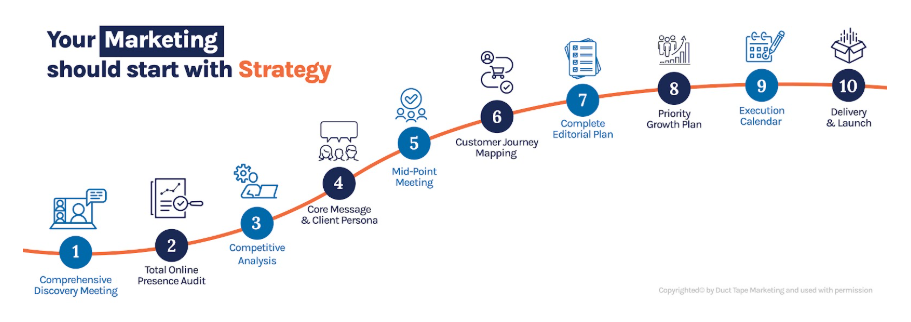
What is Strategy First? Strategy First is a structured marketing approach that helps businesses attract the right clients, differentiate themselves, and start charging a premium. It includes a full audit of your online presence, competitive landscape analysis, ideal client persona development, and a customer journey map using our proprietary Marketing Hourglass methodology. This process, completed in 30-45 days with three 1-on-1 meetings, delivers a clear marketing roadmap that businesses can implement themselves or with continued support from a Fractional CMO. Learn more about Strategy First process.

4. The Project Manager (a.k.a. The Organizer of Chaos)

Once you’ve got clients and a strategy, now you’ve got to get the work done. Campaigns, vendors, deliverables—it all needs to be managed.

Solution? Project management tools like Asana, Monday (what we use here at DTM), or ClickUp. These keep everything organized and show clients the progress you’re making without a million email check-ins.

5. The Client Manager (a.k.a. The Relationship Keeper)

If you want long-term clients (and you do), you’ve got to nurture those relationships. Regular check-ins, reports, and proving your value—week in, week out.

Solution? AI-powered reporting. Tools like SEMrush and Google Analytics spit out tons of data, but AI can help translate that into meaningful insights for your clients. Use it to show why what you’re doing matters.

6. The Marketer (a.k.a. The One Who Always Puts Clients First)

Raise your hand if you’ve ever put your own marketing on the back burner because client work comes first. Yeah, we’ve all been there.

Solution? Treat your business like a client. Assign yourself a project manager, use AI tools to repurpose content (e.g., take a blog post and turn it into LinkedIn snippets), and schedule social posts in bulk. Your future self will thank you.

7. The Accountant (a.k.a. The One Who Hates This Part)

Invoicing, bookkeeping, taxes—it’s got to get done, but that doesn’t mean you have to do it.

Solution? Outsource it. If you’re spending hours wrestling with numbers, you’re losing time you could be using to grow your business. Hire a bookkeeper and let them handle it.

How to Escape the Chaos

So, how do you stop feeling like a circus act?

  1. Prioritize the most important roles. Sales, strategy, and client management should top the list.
  2. Automate what you can. Email sequences, project management, reporting—there’s a tool for everything.
  3. Delegate and outsource. Hire a VA, a bookkeeper, or a marketing agency. Free up your time for the work that actually moves the needle.

At the end of the day, you don’t have to keep spinning plates forever. Build systems, get support, and create a business that works for you—not one that runs you into the ground.

Need help creating a system that works? Check out our Strategy First program at Duct Tape Marketing. We’ve built a repeatable framework that helps agencies and consultants scale without the chaos.


from Duct Tape Marketing https://ift.tt/kHCWG6X
via IFTTT

Thursday, March 6, 2025

Agency Growth Starts with Existing Clients

Agency Growth Starts with Existing Clients written by Jarret Redding read more at Duct Tape Marketing

The Duct Tape Marketing Podcast with Max Traylor

In this episode of the Duct Tape Marketing Podcast, I interviewed Max Traylor, consultant, author of The Agency Survival Guide, and host of Beers with Max. Max helps marketing agencies rethink their approach to agency growth by focusing on agency upselling, client retention, and long-term relationship strategies.

During our conversation, Max shared powerful insights on why agencies should move beyond constantly chasing new clients and instead focus on cross-selling strategies and client upsell tactics to generate sustainable agency revenue. From the dangers of relying too heavily on retainer agreements to the benefits of project-based pricing and strategic marketing leadership, Max explains why aligning with clients’ business objectives is the key to profitable, long-term success in today’s fast-evolving digital agency landscape.

Key Takeaways:

  • Successful agency growth relies more on deepening client relationships than constantly pursuing new clients.
  • Agency upselling and cross-selling strategies should be treated as core parts of the agency sales process, not afterthoughts.
  • Agencies should focus on providing marketing leadership services to guide small business marketing strategies, especially when internal leadership is lacking.
  • Retainers often lead to scope creep and reduced agency profitability — project-based pricing offers better control and margins.
  • Agencies that shift from transactional services to strategic marketing advisory roles build stronger, more resilient businesses.
  • Regular client check-ins, focused on business goals rather than marketing metrics, unlock new opportunities for client upsell tactics.
  • Pricing confidently — and aligning agency pricing strategies with value provided — helps agencies avoid the race to the bottom.

Chapters:

  • [00:09] Introducing Max Traylor
  • [01:29] Are Agencies in Trouble?
  • [04:25] Leadership is Missing
  • [07:00] Growing Revenue with Current Clients
  • [11:46] Are Retainers the Right Way To Go?
  • [15:36] Productizing Your Services
  • [18:01] Advice on Starting a Consulting Service Today

More About Max Traylor: 

John Jantsch (00:01.009)

Hello and welcome to another episode of the duct tape marketing podcast. This is John Jantsch and my guest today is Max Traylor. He helps agencies upsell and cross sell their existing clients. His approach centers on building relationships with decision makers and aligning with their business objectives, which ultimately leads to long-term retention and growth. Max is also the host of beers with Max podcast where he interviews other agency advisors and the author of the agency survival guide book.

series. So Max, welcome to the show.

Max Traylor (00:32.11)

Yeah, I didn't realize the intro was so long when I was writing it. But yeah, you nailed it. You got it all. What do do now?

John Jantsch (00:37.273)

I cut some out, believe it or not.

You know what? I stumbled on my name, actually, because this is my third show today. So I think I'm struggling. So did I also see you drink a beer?

Max Traylor (00:49.912)

Yeah.

No, that was water. Uh, well you, you caught me with some, uh, cambocha, you know, cause for the gut. Yeah, me too. But I, you know, I'm on, I'm on 10 and a half weeks, uh, after breaking my foot and I got out of the boot. got out of the big walkie boot thing two days ago and, yeah, beer does not help with the healing of bones. So I'm really trying. Um, I'm really trying.

John Jantsch (00:54.183)

I know, that a runner.

okay. All right. I was kind of hoping it was a beer,

John Jantsch (01:06.727)

yeah. wow. Wow.

John Jantsch (01:14.971)

I'm I'm out, out, I'm out.

Yeah, yeah. No, no, you, got to do it. You got to get back out there. So there's a lot of intrepidation in the agency world right now. I'm seeing, you know, a lot of, our mutual friend, I think I saw you comment on, Marcus Sheridan had a recent post, basically saying the, agency world is over that, you know, AI is replacing a lot of the things that agencies traditionally have done. Where do you stand on, on that? kind of sky is falling.

Max Traylor (01:23.406)

Yeah.

John Jantsch (01:49.255)

approach.

Max Traylor (01:49.856)

Yeah, I I was, I was, I was saying that 10 years ago. and that's when I started is 10 years ago. So I think, I think there's always a healthy dose of one thing going out the door, but you know, I, I was originally, I was seeing what was going on in, in the, in the Martech boost. So you got a lot of, it reduced the barriers of entry for agencies down to zero. So a lot of new entries into the market.

John Jantsch (01:53.925)

Yeah.

John Jantsch (02:11.867)

Yeah, yeah, Sure.

Max Traylor (02:18.786)

They knew how to design things because it was, you know, CMS world of like low code sites. So people could look like they knew what they were doing very easily. And it causes prices. caused prices to drop across the board. Then you had that surge of, gig network websites, which I think was the first sort of chop at the tactical deliverable.

John Jantsch (02:22.961)

Yeah, right.

Max Traylor (02:43.31)

work that agencies were doing and then I think I think AI just gave it the you the one to knockout punch on On that one. So yeah, I would yeah

John Jantsch (02:49.285)

Yeah. you also, I would say a version in there, squeezed in there somewhere, is you had all the folks that had a team in Philippines doing work and that really eroded pricing as well.

Max Traylor (03:04.054)

Yeah, sure. Yeah. just all the but I mean, I've always been in on team strategic work. I think that the the value of a third party is in their expertise, not what they can do. And the the doing of things will always go up and down in terms of you need a specialist to do it or some piece of technology just took that person's job. I think it's very difficult to have a long term sustainable professional service business.

where the service you provide is constantly changing, whether that's being taken by AI or whatever it is. But if you have something strategic, if you specialize in understanding the way people buy, I mean, that might change a little bit over the course of 10 years. And that's where you can really build up some expertise and monetize it.

John Jantsch (03:37.671)

Yeah.

John Jantsch (03:50.821)

Yeah, you you see, I've been doing this for a long time. So I've seen the wave of digital marketing agencies, social marketing agencies, know, that just like kind now you're seeing AI agencies, people just kind of hopping on the latest train, and they eventually all get wiped out.

Max Traylor (04:09.42)

Yes. the train does leave the station eventually and you're caught reinventing yourself. Nobody knows who you are. you're, you're, you're, cutting, cutting prices. Yeah. So, that's, that's sort of the narrative that I keep talking about is like, be careful aligning yourself with the tactical work. will constantly changed. It will constantly be undercut. is low margin. It's volume game.

John Jantsch (04:14.503)

Yeah.

Max Traylor (04:37.056)

And unless you're a volume player, which most of us in this game are not, then we're going get hurt out there.

John Jantsch (04:43.975)

So I have been preaching that because I think what's happening is not only strategy become more important. think especially in the small to mid-sized business that really doesn't have a marketing structure, certainly no marketing leadership, that actually providing marketing leadership as a service I think is sort of the next level of what being strategic means. I'm curious what you think about that idea.

Max Traylor (05:09.474)

Yeah, I agree with that. However, I continue to find that leadership in general and decision making in general is at an all time low. So if the idea is that we're going to provide marketing leadership and come up alongside sales leadership, product leadership, what I'm finding is that leadership just isn't there.

There's rarely a defined decision-making process. There's rarely a delegation of authority to the members of that leadership team. There's nothing that says, this is the information we're going to look at, and we're going to make a decision every quarter for our budget in this regard. So if that's not there, then what are you coming up alongside as a marketing?

John Jantsch (06:01.799)

Well, I guess my point is, is I agree with you. there's nothing to come alongside. So why don't you bring it to them?

Max Traylor (06:10.412)

Yes. And, so with a yes and, because I don't think the, I don't think your task is to bring marketing leadership. I think your task is to bring leadership and you should be prepared for the first time to facilitate a leadership planning session. So I think it's one, I think you need to skip, or just recognize that you're, you're not just leading marketing as the person that

that owns that space, you're also needing to facilitate probably for the first time, a decision making process, a planning cadence. And so you need to be well versed in the other departments in the business and you can't, you can't just assume that everything's going to function the way you think it should function.

John Jantsch (06:57.113)

I think you should assume completely the opposite. Of course.

Max Traylor (06:59.662)

Yes, assume complete dysfunction. is the way. Sometimes I talk to smaller agencies and they believe that going up market, those clients are going to have their stuff together. You and I both know that it's more chaotic the larger the organizations get, which makes it a lot easier to provide value in a strategic way because they're so dysfunctional.

John Jantsch (07:12.773)

Yeah, yeah,

John Jantsch (07:24.391)

Yeah. Yeah. It's just more meetings. It's what I've found. Yeah. So let's, let's get to your favorite topic. Shall we? I know that you have been for some amount of time talking about this idea of here's an idea. You've got a client already. Why don't you get more business out of them? Scale the relationship that you already have. So talk a little bit about, and I know you've got some success stories you could talk about.

Max Traylor (07:27.95)

It is more meetings. That's correct. Yeah. So you got to charge.

John Jantsch (07:52.699)

But talk a little bit about that mindset shift even.

Max Traylor (07:56.386)

Yeah, I mean, we want to make, we want to make revenue. Let's start there. We can all agree. We're at the, we're at the fireplace. Cool. you get revenue from two sides of the business. You get new clients and you upsell cross sell to existing clients. That's the only way to get revenue. That's the only way to grow revenue. And all of the studies are showing a downward trend in the number of new meetings, a downward trend in the number of new logos coming on. is getting harder.

John Jantsch (08:24.005)

Mm.

Max Traylor (08:25.518)

person I was interviewing the other day had some study in his hand. all do. it was meetings are across the board down 30 % in 2024 and it's only getting worse in 2025. The numbers are irrelevant. Just go ask people. You and I talked to enough people. New logos are getting harder. That's the theme of 2023, 2024. Everything was sunshine and rainbows before that. So my question to everyone out there is when new logos are hard,

why can't we look at upsell cross sell as a reliable revenue growth engine. And the reason is, no one's paying attention to it. No one's incentivizing for it. No one's training for it. No one's holding people accountable. We're completely asleep at the wheel. It's as if we hired a bunch of salespeople without incentivizing them or training them. And by the way, they've never worked in sales before. That's what's going on in the agency space.

John Jantsch (09:23.015)

All right, so let's talk about mistakes on this, because that seems like a simple concept, but it also seems like there's ways to screw it up. Because I've seen agencies that have business development folks, and they're like, no, that's my job. But they have no real relationship with the client, whereas the account manager or whoever, project manager, whatever you call them, is working with the client every day.

How do you see that working? Is it a business development function or is it train your account managers to look for opportunities?

Max Traylor (09:53.134)

I think that if it had to be a business account function, that would be better than it is today because I don't see what you've just described where an account executive that is responsible for a revenue quota is going, okay, I could sell to new logos. Okay, my pipeline's a little dry. What do we have for existing clients? Who can I upsell there? That is not the mindset because what typically happens is the principal assigns

And I say assigns in big sarcastic quotes, assigns upsell cross-sell client retention to the services side of the business. And it's actually a no fly zone. It's a no fly zone. It's a don't go there. It's not your job. You won't be incentivized for it. That's the attitude towards the sales team in an effort to, make sure they focus on getting new logos.

And so honestly, if, if we just broke down the barriers and just admitted that our service people aren't willing to aren't willing or able at the moment to pull their weight and upsell clients and you just unleashed the sales team on existing clients, I think they'd get pretty far. I think they do pretty well. But it's not happening.

John Jantsch (11:06.799)

Yeah. Yeah. How, how, are they going to identify the opportunities? mean, theoretically, the account executive is in there going over the way they should do this. We should do this. Here's an opportunity. How does, how does the sales person can identify those?

Max Traylor (11:20.618)

I don't care who it is, but to identify sales opportunities, you ask questions. And right now agencies are spending months, if not years, not asking questions at all. They're delivering reports on clicks and whatever we think the client says is their business objectives, which they're never, we're never delivering against business objectives. We're delivering some marketing metric.

John Jantsch (11:24.881)

Yeah, yeah.

Max Traylor (11:43.722)

We're talking about the things that we have delivered. We haven't had a business conversation since the sales process. That's the reality for most clients. So I don't care who does it. I don't care what dress you put on it. I don't care if you bring in a third party. If it's sales, you come in and you say, hey, I want to ask you some questions about your business. What are you? What are you? What initiatives are you investing in across the board? Let's talk about sales. Let's talk about product. Let's talk about.

finance, let's talk about anything that's not marketing. Like let's, let's just, let's talk about real stuff here. You ask questions, you understand what they're spending money on. And then you say, Hmm, how can I add value, to those business objectives? Like that's what sale that sales. So that's what we got to do.

John Jantsch (12:27.399)

Yeah. So a lot of agencies structure their fees around retainers. I know how you feel about this. So I'm just going to let you have this one. What about, what do you tell that agency says, well, we're locked into this retainer. I, I, I'm, I'll set you up. think you think retainers are not the right way.

Max Traylor (12:38.766)

Did I say that before? I don't know.

Max Traylor (12:52.182)

Well, like, you know, when you go bowling and there's the people with the bumpers? Yeah, yeah. Or or or you're riding a bike and there's training wheels. Yeah. Retainers are for the non confident. Retainers are a trade off. First of all, we all know that any retainer relationship is going to get less profitable as time goes on because the client is incentivized to get more and more from you for what they're paying. Great. So profitability goes down.

John Jantsch (12:58.95)

Yeah.

John Jantsch (13:19.111)

Yeah.

Max Traylor (13:22.104)

The other challenge is it's nearly impossible to grow or expand that account when you're on retainer, because the whole point is we're on retainer and you get whatever you need from us. So there's no upsell. Retainer also breeds this sort of complacency throughout the entire account team. And all they're thinking about is how do I hang on to this? It's a very defensive posture. Ultimately, the client starts to gain control. They start to set

scope and tell agency what to do. You've lost control, you're done, you're going to lose that account. So you see a lot of agencies that are not confident in their upsell motion go after retainers. And honestly, I think it's a false sense of security because if a client is going to cancel after month three, they're going to cancel. The fact that you have a contract that lasts a year is completely irrelevant. They could berate you across the internet and you'll be begging to get out

track. So let's be real. What is much more profitable and naturally breeds upsell is projects. Everybody hates projects because you have to keep selling them. There is a middle ground. I always tell agencies, look, you want to have that long term conversation. You want to create a roadmap that aligns with their business objectives for the course of the year, because that's when they decide how much budget is going to be allocated to say marketing.

John Jantsch (14:23.377)

Yeah.

Max Traylor (14:47.538)

But what I wouldn't do is say, OK, here's exactly what I'm to do with that budget for the course of the year. I'm going to say, look, we as as an as your new marketing leader and I know organization that you don't have a cadence, but as your new marketing leader, I suggest that once a quarter we as a leadership team get together and decide how this budget will be allocated. Will create a plan that says here the goals here are the roles, the timeline, the budget considerations.

John Jantsch (15:08.817)

Yeah.

Max Traylor (15:17.27)

And what that does is it gives you the benefit of a project because you can scope that out very defined. So you maintain your margins and you maintain control of the client account, but it also forces the leadership team, the budget holding decision makers to come to the table once a quarter and you sit and you listen.

John Jantsch (15:33.574)

Mm-hmm.

John Jantsch (15:40.241)

So this sort of relates to that. We work with a lot of, end up, I have ended up having a lot of conversations with agencies that feel like they, you know, they can't get what they're worth or what, you know, they're always in this competitive environment. How do you, a lot of times it's just, they won't charge what they're worth. You know, because they're afraid they won't get the work.

Max Traylor (15:59.446)

Yeah, honestly, step one, you don't even have to you don't have to pay me you don't have to pay john just raise your prices like you'll it's a sobering exercise. There's there's someone there's somewhere in between what you're charging today, and what you're worth and you got to find that but yes, that's that's step one for many people.

John Jantsch (16:05.221)

Yeah, yeah. Yeah, yeah, yeah.

John Jantsch (16:17.575)

Seth Godin in his last book, and I never heard this put so succinctly. said, you know, pricing is how you pick your clients and how you pick your competitors. And I was like, yeah, that's, that's very real.

Max Traylor (16:31.212)

Yeah, yeah, my dad always said, you know, if you get a yes, that all you've learned is that you didn't charge enough. No is the beginning of getting to the price that they're willing to pay.

John Jantsch (16:38.627)

Right.

John Jantsch (16:45.243)

We went through a period and I don't know if we're out of it or still in it, know, where a lot of agencies were very much trying to productize their approach, you know, package their approach, their deliverables, you know, that they could say, well, if we charge this for this deliverable, we know what our margin is. Where do you fall on that type of approach? I still see a lot of it. It seems like it's waning a little. Where do you fall on that?

Max Traylor (17:06.956)

Yeah, I mean, my first book was how to productize your consulting services. I mean, I think the term productize gets confused a lot. What I really mean is be an adult responsible service provider. Like you can't just say it's chaos. You can't say it's different for every client. No, grow up. You need a service process. Of course, clients are going to get, you know, different deliverables and things, but you have to decide these are the companies I'm working with.

John Jantsch (17:10.041)

Right. Yeah.

John Jantsch (17:14.789)

Yeah, yeah.

John Jantsch (17:23.675)

Yeah, yeah, yeah. Yeah. Yeah.

Max Traylor (17:35.362)

this is the process we're going to use to deliver the value and you have to make some decisions on on what you know, piece of the value proposition that you want to contribute to. So I for years, there's been a general lack of decision making on positioning and on service process. It's been complete chaos. So yes, I've used that term product ties just to say you deliver the same thing to the same people for the same price or you don't have a business. have operational chaos. what I've, what I,

John Jantsch (18:00.945)

Yeah, yeah.

Max Traylor (18:03.35)

I guess what I've seen is yes, more and more companies have done that. let's say 10 years ago, sales consultancy world was very mature in this area. The world did not need another sales methodology, right? There was 25 million books on this is the sales methodology and clients got tired of that. They were like, look, I don't care what, I don't care what your methodology is. Just what are you going to do for me? Marketing was about 10 years behind. had 10 years of taking chaos into these named.

John Jantsch (18:17.339)

Mm-hmm.

Max Traylor (18:33.07)

methodologies and this is our inbound thing. Now every buzzword in the English language has been claimed. Clients are fatigued. Yes, I think there's no longer this. we have this proprietary named thing. So no, I don't think there's that there's that lure to it from a sales standpoint, but you still need to create that product mindset within your services team to get

to get repeatable operations, to be able to set and meet expectations with clients. You still have to do it. It's just not like, it's not, you're not putting it in bright lights and going, look at what we can do. It's like, yeah, I look AI can tell me that too.

John Jantsch (19:13.37)

Right.

All right. So your answer may be don't, but if somebody were listening to this and saying, I'm going to start a consulting agency today, how, would you tell them? Where would you tell them to go? What would you tell them they had to have to be thinking about? What would you tell them they possibly, you know, can't possibly do?

Max Traylor (19:40.642)

Well, the first thing I would do is ask myself, where do I have experience? My grandfather always said, you have to know the territory. And the worst thing that people do, like you have perfectly capable business owners out there that start agencies, but they go through this phase of, we're going to see what works. And, you know, they ask for some referrals and they'll spend years in chaos, not really developing an identity for themselves and whatever identity they do develop.

completely tactical, replaceable, marginalized by people in decision making seats. So they have to just look at their career and say, what business acumen do I have? Okay, I'm going to do that. And they have to make that scary decision. And when they make that scary decision, you got to spend the first year talking to as many people as you can in that space, figure out what they need, do that for them. Those are those are the basics that I just don't see.

people, people do. I think you can develop an incredibly successful business if you A, choose your target market and B, are relentless about speaking to them, understanding what their needs are. those two things. I think you're good. think, I think agency is in a great place. but not for most given the mindset that I encounter, you know, day in and day out.

John Jantsch (20:54.748)

Yeah.

John Jantsch (21:02.053)

Yeah, I said a billion times, people don't care, don't want what we sell. They want their problem solved. I think that's what, that's what we have to continue to focus on. Yeah.

Max Traylor (21:10.188)

Yeah, so you are you are problem finders. So you got to your thing, you got to go figure out what their problem is. And then you got to help them solve the problem. I would I would still say that, you know, there are are two steps to solving a problem. It's helping the client understand how to solve that problem. That I think is where the money is. That's selling knowledge that's selling expertise. Then there's the doing of that thing. That's the commoditized area that's either going to be my AI or, you know, shark.

John Jantsch (21:27.463)

Yeah.

Max Traylor (21:39.278)

Price chopped chum water with.

whatever generation is entering the market now, I can't keep track of it. But those guys, those people.

John Jantsch (21:47.431)

Yeah. Yeah. Yeah. Yeah. Yeah. Yeah. Yeah. Yeah. Yeah. Yeah. Yeah. Yeah. Yeah. Yeah. Yeah. Yeah. Yeah. Yeah.

Max Traylor (21:55.197)

Uh-huh. But they're out there cutting prices is what they're doing.

Max Traylor (22:09.046)

As a great new social network, LinkedIn. Yeah. Max trailer, LinkedIn. I'm always saying opinionated things and posting videos.

John Jantsch (22:11.717)

Yeah, okay. Yeah, that's

John Jantsch (22:17.605)

Yeah. No, your, your feed is, is, lively and interesting. How's that? That was a tough one. Okay. That's how it was, man, as well. Again, thanks for stopping by. Hopefully we'll run into you one of these days out there on the road.

Max Traylor (22:23.458)

Thank you.

Max Traylor (22:26.978)

Yes, I took it as such.

Max Traylor (22:35.054)

Cheers.


from Duct Tape Marketing https://ift.tt/iDcrb2s
via IFTTT

Wednesday, March 5, 2025

How Small Businesses Win on Reddit in 2025

How Small Businesses Win on Reddit in 2025 written by John Jantsch read more at Duct Tape Marketing

The Duct Tape Marketing Podcast with Jim Squires

In this episode of the Duct Tape Marketing Podcast, I interviewed Jim Squires, Executive Vice President of Business Marketing and Growth at Reddit. We explored how small businesses and marketing agencies can tap into Reddit’s communities to build authentic engagement, run effective Reddit Ads, and grow their brands through community-based marketing. Whether you’re looking for tips on Reddit organic engagement or want to maximize Reddit advertising for your business, Jim shared actionable strategies every small business owner and digital marketer should know.

During our conversation, Jim highlighted how Reddit marketing strategies differ from traditional social media marketing. With over 100,000 active Reddit communities, businesses can reach highly engaged, niche audiences in ways that simply aren’t possible on other platforms. From interest-based targeting to upvote/downvote dynamics that prioritize authentic content, Reddit for businesses offers a unique opportunity to build community trust while driving both awareness and conversions.

Key Takeaways:

  • Reddit is a community-driven platform where users gather around shared passions and interests, creating valuable opportunities for niche marketing strategies and online community marketing.
  • Unlike traditional social platforms, Reddit’s upvote/downvote system ensures the most helpful and engaging content rises to the top, rewarding brands that embrace authentic brand voice and transparency.
  • Small businesses can launch targeted campaigns quickly using Reddit Ads, benefiting from interest-based targeting that puts their message in front of the right communities without needing large budgets.
  • Reddit Pro, a free tool, helps businesses monitor trending conversations, track competitor mentions, and identify new content strategies through the Reddit trends tool.
  • Combining paid Reddit advertising with organic Reddit engagement allows businesses to build community trust while driving both brand awareness and sales.
  • For marketing agencies, Reddit offers unique reach into hard-to-access communities, especially for B2B marketing and localized small business marketing.
  • Successful brands on Reddit embrace transparency, engage directly with users through formats like AMAs, and avoid overly polished or sales-driven messaging, which is heavily discouraged by community self-promotion rules.
  • As online conversations and trust become critical to customer decision-making, Reddit offers small businesses a chance to be part of the dialogue in a way that builds long-term credibility and customer loyalty.

Chapters:

  • [00:09] Introducing Jim Squires
  • [00:56] How Does Reddit Differ From Other Platforms?
  • [04:20] Impact of Search on Reddit
  • [05:54] Best Practices for Businesses on Reddit
  • [08:17] How Does Advertising Fit in on Reddit
  • [10:52] Getting Organic Reach on Reddit
  • [13:05] Small Business Mistakes on Reddit
  • [15:47] How to Measure Success on Reddit
  • [18:34] Meeting People Where They Are

More About Jim Squires: 

This episode of the Duct Tape Marketing Podcast is brought to you by

Want to elevate your marketing game? AdCritter pairs Connected TV ads with precise digital retargeting to drive real results. Discover how their full-funnel strategy can help your business grow smarter. Let them know Duct Tape Marketing sent you, and you’ll get a dollar-for-dollar match on your first campaign! Learn more at adcritter.com.

John Jantsch (00:00.981)

Hello and welcome to another episode of the Duct Tape Marketing Podcast. This is John Jantsch. My guest today is Jim Squires. He's a Reddit's EVP of business marketing and growth. He oversees the strategy and expansion behind Reddit's marketing efforts as they relate to our growing advertiser base. So their growing advertiser base is probably what I should have said. Jim, welcome to the show.

Jim Squires (00:23.662)

Hi John, it's great to be here.

John Jantsch (00:25.437)

So I told you off air that I had Alexis on the show about five or six years ago. He's no longer involved at all, In Reddit, Yeah. Yeah, yeah, yeah. So let's talk a little bit about, you know, I think Reddit has started to get lumped into social platforms. I'm not sure that's where they started. It certainly has its own.

Jim Squires (00:35.975)

Correct. Yep. Steve Hoffman is our CEO and founder actually from the very beginning.

John Jantsch (00:53.579)

personality, I guess, if you will. So talk a little bit about how the unique culture at Reddit on the platform kind of differ, is different from say LinkedIn and Facebook and some other social platforms.

Jim Squires (00:59.97)

Yep.

Jim Squires (01:05.176)

Yeah, yeah, it is unique. It's a very different platform. It is, I describe it as a community of communities. And so you've got a hundred thousand plus active communities, everything from gaming to gardening, tech to travel, investing to interior design, really anything that you can think of is on there. And so people organize around their interests and their passions.

And it's very different from other platforms in the sense that even the dynamics, there's not likes on the platform. There's up votes and down votes, which means that only the really universally valuable, interesting things float up and get distribution. The stuff that's really divisive or controversial gets a lot of up votes and down votes and then never gets anywhere. So it feels very different. It's anonymous. So people use pseudonyms on the platforms. And so there's a lot of different dimensions, but the biggest thing

John Jantsch (01:38.923)

Yeah, right.

Jim Squires (02:02.318)

to think about is those communities and the passion and how people organize around that.

John Jantsch (02:05.525)

Yes.

Yeah, and really niche, right? mean, like subreddit, subreddit, subreddit of, you know, a very small community, right? But the people that are in that community are not just casual passerbys. I mean, they are like totally into it,

Jim Squires (02:21.838)

Yeah, yeah. I you have massive communities. There's communities like be amazed or which car should I buy that have millions of people in them. And then to your point, you can go super niche and super deep into specific categories as well. So it really runs across the board.

John Jantsch (02:33.953)

Yeah.

John Jantsch (02:41.825)

So in terms of communication, engagement, participation, how would you say, you know, there in the early days, particularly, there was kind of this vibe of like behave here and be a good citizen or, know, you'll get kicked out kind of thing, as opposed to say, I don't know, all comers on Twitter or something, you know, might've been. So I'm sure as Reddit has grown, you know, some of that's probably gone away, but would you say that that, that sort of DNA still exists? Yeah.

Jim Squires (03:10.218)

It definitely does. It is a, part of what I was describing before with this up vote, down vote dynamic that keeps bad behavior from bubbling over because it just, you're just not rewarded for doing anything in that, in that area. You've got moderators for each of the communities that have their, their own rules and they govern how that community is going to, to engage. so,

John Jantsch (03:24.107)

Yeah, yeah.

Jim Squires (03:35.822)

between the rules of engagement and knowing that if you're going to step out of line or behave poorly, one, no one's gonna probably see it, and two, the moderator might ban you or take you out of that community. So it really keeps things positive and helpful for people.

John Jantsch (03:47.445)

Yeah, and-

John Jantsch (03:52.85)

And, poorly is not just calling people names. mean, it's self-promotion too, right?

Jim Squires (03:57.294)

That's exactly right. People, and this is great advice for small businesses as well, is people don't, which is not unlike anywhere, even in our personal lives, they don't like to be marketed to. They want to be spoken to. They know there's humans behind these businesses and the more you can show that humanity of the business and engage with people in a way that doesn't feel like you're just being salesy or too overly polished, that resonates really well, especially on Reddit.

John Jantsch (04:07.809)

That's right.

John Jantsch (04:25.451)

Yeah. So one of the things that it's probably been going on longer, but certainly has been very noticeable maybe for the last three years is that, you know, Reddit used, it feels like Reddit used to exist in its own universe. And now you can't do a Google search that doesn't usually turn up some Reddit conversations. So how has that changed the dynamic of the platform?

Jim Squires (04:45.772)

Great. Yeah.

It has, mean, it's interesting because Reddit's been around for 20 years doing its thing. And there actually is just this rich repository of all these conversations that have happened over 20 years. But it really has become even more important and it's having a cultural moment right now because, and my view on this is because there's so much AI-generated content and search, AI-generated search results pages and

John Jantsch (05:09.013)

Yeah.

Jim Squires (05:18.616)

People have grown tired of paid influencers. They see through that and they're much more savvy on being sold to. And so there really is this desire to have a more authentic connection, really hear from people, hear their real opinions about things. And so many people, to your point, they come in through a search. they're looking for, they're going camping and they're getting into camping. Gear is a really big part of any hobby and passion that you have.

John Jantsch (05:46.849)

Yeah, yeah.

Jim Squires (05:48.268)

looking for something in particular, Reddit pops up in the search results and then they find themselves now in these conversations. So a lot of people discover Reddit through search and then they stay for the community because they realize, wow, there's so much more here beyond just that camping gear I was just looking for.

John Jantsch (06:04.651)

Yeah. So, however, commerce is happening, right? on Reddit. So, so let's talk a little bit about, if I'm in a small business and I thought, I'm playing on all these other platforms. How can I get into Reddit? Or if I'm an agency and I'm thinking, you know, how do I bring my clients, and get value out of Reddit? You know, I'm sure it depends on the business and the niche and what your goals are.

Jim Squires (06:10.188)

Right, it is, definitely.

John Jantsch (06:29.877)

But in general, is there kind of a best practice approach to get yourself up and going on Reddit?

Jim Squires (06:37.004)

Yep. I we keep it really simple and it's relevant for really whatever category you're in or whatever business that you're running. There is a really easy to use ads interface. is the easiest way to, you small businesses don't typically have a lot of time. They want to get to results and find new customers quickly. And so we make it easy to through ads, just quickly get distribution. And so you can take, you know, if you're running advertising on another platform,

make it really easy to import that campaign over. You can use the AI tools to automate things and just get it going really quickly. And really, just with a few hundred dollars, you can start seeing progress and seeing and getting new customers. In fact, we should throw it in the notes, but we have for duct tape marketing listeners, we've got a promo code, duct tape 500 that they can use to get started on ads if they want to. But I recommend that's just the easiest way to dip your toe in is just get

ads going and I can talk more about tactically how that works. And then the other thing I want to call out is we have a free set of tools to also get going. And so we call it Reddit Pro. And through Reddit Pro, you can get your official presence on Reddit, so your official profile, and you can start actually seeing trends. So what are people saying about your business, your competitors? What are people talking about in your category? What's trending? What's interesting?

John Jantsch (07:36.683)

Yeah. Yeah.

John Jantsch (07:58.497)

Hmm.

Jim Squires (08:02.67)

and then actually shows you which of those communities you can go into and learn more. And you can even start engaging as the official business. People love to hear from businesses when they're authentic and they're talking as humans and getting some inside tracks. That's the other thing you can do.

John Jantsch (08:13.974)

Yeah, yeah.

Yeah. Serving and solving problems, right? So, so let's, I want to get back to organic in a minute, but let's touch on the advertising again. You said it's duct tape 500. that's D U C T T A P E 500. And if you spend 500, you're going to get 500. So that's kind of the way that deal works. How does advertising, I know some platforms that were traditionally very organic and then figured out, we got to make money.

Jim Squires (08:19.812)

I like that, yes, well said.

Jim Squires (08:34.562)

That's right. That's right.

John Jantsch (08:45.069)

we're going to sell ads. The ads, they struggle with how do we get those in? How are people going to view those? And obviously an ad is a call to action quite often, by now kind of thing. So how does that fit in culturally?

Jim Squires (08:57.742)

Mm-hmm.

Jim Squires (09:03.406)

Well, it's interesting. We took the reverse approach. So we started with ads before the organic. And so people got used to it pretty quickly as far as how it fits in. mean, a big part of it is kind of thinking about what communities are going to be most relevant to you. And we made that really easy as well. So for example, health and well-being, there's lots of communities in that realm. So everything from

John Jantsch (09:09.387)

Okay.

Jim Squires (09:32.142)

The communities are always structured r slash. So r slash get motivated, r slash weight loss, r slash fitness. These are all in that health and wellness category. But as a small business, you don't have time to go through and try to figure out which of these communities is going to be relevant to you. So you can just tag health as a interest category that you think is relevant for your products. And then the ad system will go out and pull all the relevant

communities that might be of interest and the people that are in those communities, it's anonymous, so that you can then get your ad in front of them either in those communities or when they're in their feed or they're in some other community on the site. So it's a really easy way to get into those interests and then your product is gonna be very relevant for those individuals because they've expressed interest in that area.

John Jantsch (10:26.155)

So let's say I want to do a combination. I want to actually build an organic presence as well as doing some advertising. What's a, you know, it's probably not an overnight solution, but what is, what's a kind of best practices approach for getting some organic reach on?

Jim Squires (10:43.82)

Yeah, yeah. Well, you would want to set up your official profile. So you get that. This is now my business on Reddit. So people know that you're the official voice of that business. And you really want to start. We just released a new product called Trends that's free as part of Reddit Pro. And I always suggest just quickly jumping in. can actually specify.

John Jantsch (10:48.289)

Right,

Jim Squires (11:09.966)

keywords that you think are interesting or related to your business. And you can start seeing through your category what might be trending, what are people talking about? Are people talking about my business? Are they talking about my competitors' businesses? What are they saying? And that gives you an entree into, okay, do I want to engage yet? Or I just want to kind of check things out and see what the tone is and see what's happening there. Now the businesses that really...

elevate and do really well are actually they start engaging and they start interacting with the community and people really appreciate. We talked earlier about showing the humanity of the business. They appreciate transparency. So having the good and the bad, it's being, it's, you know, talking about things that maybe not aren't perfect, gets you a lot of credibility in a community and across Reddit. There is a

a business that's on Reddit that sells diaper bags, like travel diaper bags. It's called the No Reception Club. And they jumped on there and they're running ads. They also have an organic presence. And people were commenting that the bags were too expensive. They had really high price point. And so instead of just kind of withering away or not addressing that,

John Jantsch (12:11.233)

Yeah.

Jim Squires (12:31.256)

they hit a head on and started talking about why it's a high price point because of all these features, the quality, they've got a lifetime warranty and that built so much credibility with people in those communities and went over a lot of people that were saying, I see, they actually engage in me and explained what is going on and that just gives you a lot of points.

John Jantsch (12:52.479)

Yeah, sure. So what are some of the challenges you've seen or maybe we could even say mistakes you've seen small businesses make, you know, really trying to engage on Reddit.

Jim Squires (13:03.778)

Yeah, yeah. Well, I mean, kind of the mistakes that get made relate to what we were just talking about. So you cut you come in and you can imagine like, like as humans, we don't walk into a meeting or walk into a party and just start shouting about ourself. You you you ease your way in. You start talking. You get you get a feel for the vibe and what's happening. And then you can talk about yourself and what you're doing. And so the brands that that would show up or businesses that show up and and we coach on this so it doesn't happen.

very often, but if you show up and you are just just shouting with salesy messaging and and not being authentic and engaging that way, it's a you're not going to get shouted away. I you can show up with ads. People are used to ads and they're not going to, know, you can turn off comments and not really worry about it that much. But again, as we were saying before, if you really want to elevate, you really want to have success in the platform. Being aware of that, even turning comments on.

because you want to hear from people and you want to understand your customers, that's kind where you elevate to the next level.

John Jantsch (14:08.289)

Ken, is there a type of content that performs questions, behind the scenes insights, educational posts, AMAs? mean, is there a certain type that you think performs better?

Jim Squires (14:17.486)

Yeah, that's a great question.

I love that. It's not one specific type, but I like where you're going. The angle on this is, within the different formats, what type of content might resonate. And I would say that, in general, that transparency and being willing to engage always does well. So the AMA is a perfect example of that. There was actually Oatly, the oat milk brand. I love they did an AMA and they invited

Big dairy, know, big dairy businesses to come co-host with them and talk about climate footprint labeling. No one from Big Dairy showed up on that and took them up on it. Well, that small dairy showed up and there was a Scottish dairy farmer that showed up and actually engaged and talked through and they had a really good dialogue. So that type of content does well. Behind the scenes content is really, really good. I mean, you can imagine a microbrewery

John Jantsch (14:53.131)

Yeah, yeah.

Jim Squires (15:19.778)

taking you behind the scenes on how they brew their IPAs and people really want to geek out on that. They want to see the technical aspects of it, understand what's behind the scenes. And what it does is it shows when you show, because we all, with each of our businesses, we have a passion for what we're doing. That's why we started that business. And so when you show that enthusiasm, that passion and that craft, these people in the communities, they have the same passion. And so it really resonates with them.

John Jantsch (15:28.715)

Yes.

Jim Squires (15:48.396)

and then they want to lean in and they want to learn more about

John Jantsch (15:52.363)

So imagine the CEO sitting around saying, okay, my agency says I need to be on Reddit. How do I know if I'm getting any return on being there? What type of reporting, what type of measurement is available for somebody to know? Am I having success?

Jim Squires (16:02.359)

Yeah.

Jim Squires (16:09.57)

Yep, yep. mean, that's, that is the key. What am I, what have I accomplished here? So Reddit is a, it is, it's multi objective. So it really, it really goes from, you know, top of the funnel reach all the way down to driving sales with what you're trying to do. And so it depends on where you're at in your life cycle and kind of what you're trying to achieve. But I think about on the, discovery side, so people are showing up and they're really open minded. They want to discover new products and services.

I do look at the overall reach that you're getting inside of these different communities and try to understand that. I think for most small businesses, they want to move faster and they want to just get new customers. And so then I suggest looking at the traffic that is coming off of your advertising and your organic presence. You can measure that directly and see what traffic you're getting. And then ultimately, I look at the conversions and the new customers.

that you've converted and the purchases that you can drive. So as part of the reporting, you have access to all of that to go to instrument it. And then based on your campaign, what you're trying to achieve, that's actually the key thing is a lot of times businesses show up and they haven't crystallized. What am I actually trying to do with this campaign and making sure the creative ties to that? But having that really clear and then looking at the appropriate stats for that is really what I recommend.

John Jantsch (17:22.879)

Yeah, yeah, Right. Yeah.

John Jantsch (17:33.835)

So you mentioned the word creative. Is there a form of creative, you know, maybe that's a little more tongue in cheek, a little more, or a little more cynical or, you know, just rather than just the traditional, we're the best, bye from us.

Jim Squires (17:46.382)

Yeah, yeah, yeah. Well, there's lots of memes on Reddit, definitely. You can play into that, and some brands really do that. My advice on the creative is not unlike advice you would give a friend is be yourself on this. And so if you are a really tongue in cheek, kind of clever brand, then that should come out in your creative. If you're not, and you're doing

John Jantsch (17:50.093)

Right.

John Jantsch (18:01.695)

Yeah, yeah, yeah.

Jim Squires (18:12.858)

You know, B2B is huge on the platform. And so if you're doing some, somebody's B2B, that's more serious and that you feel like that's actually not your thing. you don't want to show up on Reddit and then start doing that. Cause that stands out as well. So I always like to have the, what, what, what are you as a brand? What do you stand for? What are you trying to communicate? And then have that tie in versus trying to, change yourself, to try to fit in or, or feel like it's reddity or something that's, that's, that's going to fit in there.

John Jantsch (18:35.904)

Yeah, yeah.

Yeah, it's probably no, no faster way to fail than to try to be something you're not right. Right. So one of the things that we've seen over the last couple of years, you know, ties into AI ties into zero click, you know, searches, now is that, advice we're giving people is like it or not. You've probably got to be a few more places where people are choosing to get their information and hang out.

Jim Squires (18:44.866)

That's right. As people in life or on platforms. Yes, exactly.

John Jantsch (19:08.737)

And it's not always search engines. How have you seen that impact Reddit or have you? guess I should ask first. Yeah.

Jim Squires (19:09.005)

Yeah.

Jim Squires (19:13.186)

Yeah, mean, it's absolutely it's a great it's a great point. mean, there is a one one thing that is interesting about Reddit is that it has a lot of unduplicated reach. So people that are on Reddit that are on Facebook or Instagram or other other places. And so that is that's counterintuitive because these other platforms are so big. But there actually are a lot of people that are on those other platforms. So being able

John Jantsch (19:38.581)

Well, and I suspect trust has a lot to do with it.

Jim Squires (19:42.562)

Yes, what they look at, that's a great point. mean, people, it's anonymous as we talked about before, people are sharing their unvarnished real opinions. And so people trust that because they're enthusiastic. Yeah. So I think that ability to get to customers that you can't get to on other platforms is something really to consider and think about when you're looking at it.

John Jantsch (19:43.553)

Or lack thereof. Yeah, yeah.

Yeah. Yeah.

John Jantsch (20:08.651)

Yes.

Jim Squires (20:08.812)

And so, yeah, so I think it does, that's one of the things on why you would want to branch out. The other reason is that you have on all the different platforms, people are in different mindsets and they're doing different things, which really affects what they may want to be purchasing or the decisions they may want to be making. So for example, on most platforms, targeting based on demo is really the standard.

John Jantsch (20:38.079)

Yeah.

Jim Squires (20:38.274)

If you were targeting me on another platform, you're going to know that I live in San Francisco. I'm in my forties. you may know, you may know where I work. You know, there's like certain things that you know about, about me. Well, you wouldn't know that, know, on Reddit is that I'm really into mountain biking and that I'm in the market right now to get a, a, a heavy duty, bike rack for my car that can hold four bikes. Cause I want to have my kids and my wife be able to go with, with me.

John Jantsch (20:50.315)

Yeah.

John Jantsch (20:55.477)

Yeah.

John Jantsch (21:06.241)

Mmm... Yeah.

Jim Squires (21:08.002)

and that it can go long distances up into the mountains. You wouldn't know that on another platform. And so that's the different dimension. And so as a business, you wanna be where your customers are and you wanna be where they are making purchase decisions. We always say that conversations drive decisions. And so people are making those decisions through the process. That's what I encourage.

John Jantsch (21:21.835)

Yes.

John Jantsch (21:27.553)

Yeah. And I certainly notice a lot of, anybody got advice on, know, kind of post, which is pretty high buyer intent, right? Um, yeah. So by the way, the Thule hitch rack, I swear by it. That's the way I would go. That's the way I have gone. and, and, and so now, now we need to talk about your, your, your setup on your bike. Uh, I'm a, I'm a Santa Cruz guy myself. Okay. Awesome.

Jim Squires (21:34.318)

That's right.

Jim Squires (21:39.162)

Is that the way to go? Okay. Okay, that's enough. I'm down to three right now.

Jim Squires (21:50.401)

I'm a Santa Cruz guy also, so I'll get to 50-10, yes.

John Jantsch (21:54.461)

Awesome. There's probably a Santa Cruz subreddit or at least a mountain bike subreddit.

Jim Squires (21:57.806)

They're 100 % there. I was going to ask you, do you spend time on Reddit? How much do you spend phone?

John Jantsch (22:02.825)

Yeah, we have the, have, we do a lot of training of fractional CMOs and marketing consultants and agencies. So we participate in a few of those conversations for sure. Yeah.

Jim Squires (22:13.966)

Okay, there's a lot of great small business communities, small business marketers. And so you can kind of as business use it in multiple ways. You're using it to get to your customers and potential customers. And then you're also using it for your own benefit for advice and understanding how to run your business along with other small business owners.

John Jantsch (22:35.391)

Yeah. And I mentioned that's actually a pretty, pretty good way to start getting engaged is go in there and just start asking questions, right? mean, of stuff you truly want to know, that probably is going to create some engagement all on its own. Cause people love to give answers. Yeah.

Jim Squires (22:41.806)

Yep, definitely.

Jim Squires (22:48.774)

That's exactly right. There's nothing when you, and I also encourage people to say, people to when they start using it, when you do that first post and people start up voting it and you get literally karma points, that's what we call it. So it shows you feel like, wow, I just added something of value to the universe. I'm getting these karma points. It feels really good. It's like you're contributing to this community. It's a nice feeling.

John Jantsch (23:06.261)

Yeah. Yeah. Yeah.

Well, Jim, I want to thank you for something by the duct tape marketing podcast. is there someplace you invite people to connect with you? Obviously we've been talking about Reddit, reddit.com. we got a special for you listeners, a duct tape 500 to get some ad spend. Is there anywhere else you'd want people to connect with you?

Jim Squires (23:30.382)

We have a young on on Reddit, of course, I'm Jim at reddit.com. I'm happy to connect with people and and yeah, just it's great great being here I'm a fan of the the podcast and love what what you do with small businesses. So thank you for having me

John Jantsch (23:47.381)

Thanks so much again. Hopefully we'll run into you. I've got a daughter that lives out in the Bay area, so maybe we'll run into you one of these days out on the road. Awesome. Take care. Thanks.

Jim Squires (23:53.666)

I would love that. I would love that. Thanks, John. Take care. Bye-bye.


from Duct Tape Marketing https://ift.tt/XrdKZsf
via IFTTT

Tuesday, March 4, 2025

Weekend Favs March 1st

Weekend Favs March 1st written by John Jantsch read more at Duct Tape Marketing

My weekend blog post routine includes posting links to a handful of tools or great content I ran across during the week.

I don’t go into depth about the finds, but I encourage you to check them out if they sound interesting. The photo in the post is a favorite for the week from an online source or one I took on the road.

  • Outranking.io is an AI SEO tool that helps create and optimize content to rank higher on search engines. invitations, and a sleek, modern interface.
  • Narrato is an AI content workspace that helps with content creation, optimization, and collaboration.

  • GrowthBar is an AI SEO tool that provides keyword research, content outlines, and competitor analysis.

These are my weekend favs; I would love to hear about some of yours – Connect with me on Linkedin!

If you want to check out more Weekend Favs you can find them here.


from Duct Tape Marketing https://ift.tt/UtkeLT3
via IFTTT