Thursday, January 30, 2020

Break Free B2B Series: Margaret Magnarelli on the Psychology of Trust for Better Content Marketing

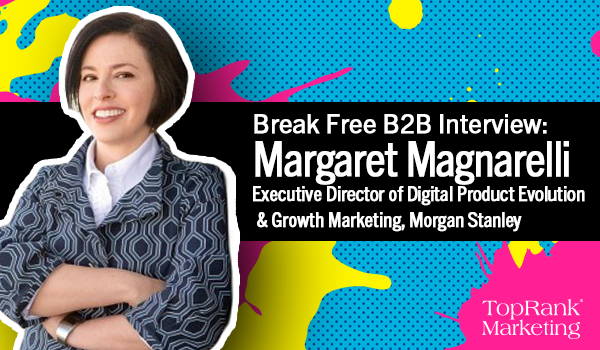
Break Free B2B Interview with Margaret Magnarelli

Break Free B2B Interview with Margaret Magnarelli Trust in marketing—how to build it and how to wield it for good—needs to be top of mind for every modern marketer. Why? Because nearly every decision people make, especially when it comes to purchasing decisions, has an element of trust built in. And content marketers have the opportunity to become trusty guides. “No one knows everything about everything,” Margaret Magnarelli, Executive Director of Digital Product Evolution and Growth Marketing at Morgan Stanley, shared with us in a recent Break Free B2B interview. “So, we have to be able to give our customers as much information as we can… and take them as close to the line of purchase—to the experience of purchase—as we can.” According to Margaret, understanding and leveraging the psychology of trust—the intellectual and emotional factors that guide our trust instincts—can be incredibly powerful. But building trust isn’t a solo marketing department endeavor (or ploy). “If you want to be a trustworthy company… it can’t be just a marketing philosophy. It has to be a business philosophy," she said. “People can see through fake attempts to build trust. So, I would caution brands away from being all things to all people.” [bctt tweet="If you want to be a trustworthy company… it can’t be just a marketing philosophy. It has to be a business philosophy. @mmagnarelli #BreakFreeB2B #TrustInMarketing" username="toprank"] From the four “trust factors” to engaging the C-suite around trust to key metrics, listen into Margaret’s full audio interview with TopRank Marketing President Susan Misukanis below.

Break Free B2B Interview with Margaret Magnarelli

If you’re interested in checking out a particular portion of the discussion, you can find a quick general outline below, as well as a few excerpts that stood out to us.
  • 1:10 – Why marketers need to car about building trust
  • 2:50 – Four factors of trust
  • 5:20 – Trust as a corporate value
  • 7:12 – Where marketers can make a difference in building trust with consumers
  • 9:40 – Maintaining authenticity while tailoring messages to audience “weaknesses”
  • 10:57 – Building brand intimacy with consistency
  • 13:20 – The bottom-line impact of “trust incidents”
  • 15:16 – Engaging the C-suite around trust
  • 19:20 – Measuring and monitoring brand trust
  • 20:30 – Intertwining trust messaging in current content marketing projects
  • 22:18 – Building trust under pressure to drive results
  • 23:15 – The state of trust in marketing in 3 to 5 years
  • 24:57 – How marketers can break free
Sue: How are we providing prospective customers the information they need to bring them as close to the line of purchase as possible? How does trust factor in? Margaret: ... Trust comes out of two different parts of our brain. There's the cognitive part of trust that comes out of logic and proof points and data. And then there's the intuitive part of trust that comes out of our feelings and our intuition or heart. And interestingly enough, some of the research that has been done by marketing academics, has shown that [when there’s a] higher price point for a purchase, the more that process becomes intuitive rather than cognitive.  [bctt tweet="Trust comes out of two different parts of our brain. There’s the cognitive part that comes out of logic, proof points, and data. And there’s the intuitive part that comes out of our feelings, intuition, or heart. @mmagnarelli #BreakFreeB2B " username="toprank"] In any case, there are four major themes and factors into the trust analysis that we do. And they are benevolence, capability, authenticity and honesty So, benevolence: We want to know… does this person have our best interests at heart? Capability: Can they actually do the things that they say they can do? Authenticity: Are they real and genuine? And honesty: Are they truthful and transparent and what they're doing? And so using these four factors, and making sure that we are telling our stories with that framework in mind can really help us to establish trust with consumers. Sue: Where do you think the gaps are in terms of getting to that trust utopia? Margaret: I think that part of it comes from people's initial perspectives on trust. There's one thing that we can't really overcome as brands and that's people's trust disposition.  So, if you look at the psychological research—with Erik Erikson, the developmental psychologist—the first phase of development is earning trust. It's the first task of the ego, he has said. And, and what, what that means is that we learn whether or not to be trusting individuals in those first 18 months of life because as babies if you're crying, are your needs being met? Is someone coming to feed you or put you in bed or hold you? If you are not in a household that has that level of responsiveness and care, you might actually have a very low trust disposition— meaning that you are disinclined to trust, versus someone who was in a household that was very responsive to that and they have a high trust responsiveness.  Now that is something that our consumers all come to us with... it's their personal history, and we have no ability to change that right. So where we have the ability to change things is in those four factors that that I was talking about—the capability benevolence, authenticity and honesty… The things that we could do more of as content marketers is, I think, the capability aspect… Making sure that we are not just telling people that we do with thing, but like really showing them…  So how can we actually in video form or even in text form, like really prove to the people that our products work? And I think that also comes out of using third party validation where we can… It's hard for consumers to just believe a brand when they say they can do a thing. So if you have other people who say you can do a thing and you can do it well, and they can be your advocates, that's really powerful. So that's another area that I think that we really have the ability as brands to continue to leverage… Looking for our customers to help be our advocates, and looking for those outside proof points, and sharing those with our audiences so that they can understand how things work. [bctt tweet="It’s hard for consumers to just believe a brand when they say they can do a thing... That’s where third party validation can be really powerful. @mmagnarelli #BreakFreeB2B" username="toprank"] Sue: You talk about “trust incidents”—Can you share a little bit about that? Margaret: The main reasons that people lose trust with brands or what you would expect. So the primary one is poor product experience, like someone has not achieved the goal that they were looking to achieve with the product, or the product and didn't deliver in some other way, or felt they felt negative after the product experience. The second one is poor customer experience. But then some of the other reasons that people lose trust are again, things that you would probably expect, things like security breaches, leadership scandals, and that sort of thing… When something happens on a mass scale, like a leadership scandal or a security breach, companies really suffer the data shows that they suffer. I think it was an average 5% loss in revenue growth for the year that the trust incident happened; I believe that Accenture did that study. Stay tuned to the TopRank Marketing Blog and subscribe to our YouTube channel for more Break Free B2B interviews. Here are a few interviews to whet your appetite: If you’re hungry for more insight and advice on the state of trust in marketing, check out our Trust Factors series:

The post Break Free B2B Series: Margaret Magnarelli on the Psychology of Trust for Better Content Marketing appeared first on Online Marketing Blog - TopRank®.


from Online Marketing Blog – TopRank® https://ift.tt/36JXQuZ
via IFTTT

Wednesday, January 29, 2020

Choosing a marketing automation platform

Who are the major vendors? What should I be looking for? What are the costs?

Please visit Marketing Land for the full article.


from Marketing Land - Internet Marketing News, Strategies & Tips https://ift.tt/38S4OiC
via IFTTT

Is your marketing department the ‘useful idiot’ of your business?

In politics, the useful idiot is someone who can be misled into supporting a dubious cause that goes against his own best interest. In marketing, the outside actor here is ignorance and it’s time to change that.

Please visit Marketing Land for the full article.


from Marketing Land - Internet Marketing News, Strategies & Tips https://ift.tt/2U6j5UU
via IFTTT

The Seb Rusk Show – The Self-Reliant Entrepreneur

The Seb Rusk Show – The Self-Reliant Entrepreneur written by John Jantsch read more at Duct Tape Marketing

John Jantsch appears on The Seb Rusk Show on SocialBuzzONAIR to discuss his latest book, The Self-Reliant Entrepreneur.

Jantsch has been in the marketing industry for his entire career, and he started his own business three decades ago. He’s been on an entrepreneurial journey since then, and has seen the world of marketing evolve from the early days of blogging and podcasting over a traditional phone line to the dozens of social channels and new digital media trends we see today.

On this episode, after talking a bit about his professional background in marketing and entrepreneurship, he dives into talking about his sixth book, which is not like his previous five marketing how-to books. He discusses the sources of inspiration for this book and even shares an excerpt from the daily entries.

Listen: John Jantsch on The Seb Rusk Show on SocialBuzzONAIR


from Duct Tape Marketing https://ift.tt/2S0Z8fr
via IFTTT

Marketers should be able to get more than 60% location opt-ins if they follow best practices

Control and value are key to convincing the “it depends” crowd to share their data.

Please visit Marketing Land for the full article.


from Marketing Land - Internet Marketing News, Strategies & Tips https://ift.tt/3193RAa
via IFTTT

How to Form an Effective Hypothesis for Optimized Testing

A strong hypothesis is the cornerstone to any meaningful and effective test. Every hypothesis that is proven or rejected provides your business with valuable insights behind visitor behavior and continues to drive your optimization plan while supporting company goals and objectives.

Remind me, what exactly is a hypothesis?

Before we dive into the components and best practices you should keep in mind when crafting your hypothesis, let’s first discuss what exactly a hypothesis is. If you type “hypothesis” into Google, you’ll likely receive a definition similar to the below:

“Hypothesis: a supposition or proposed explanation made on the basis of limited evidence as a starting point for further investigation.”

In simpler terms, a hypothesis is a prediction you make before running an experiment or test. It is a statement that addresses a specific problem or question while also providing a suggested solution. 

Hypotheses should be informed by quantitative data (web analytics, past test data, campaign insights, audience insights, heat maps) and/or qualitative data (user testing, focus groups, customer support feedback). The hypothesis created based on this information will clearly state what is being altered, what the predicted outcome of this alteration will be, and the rationale behind that prediction. 

Ultimately, the outcome of the test will either prove or disprove your hypothesis.

So, how do I create my own hypothesis?

When beginning to craft your hypothesis, you’ll want to first ask yourself what the problem, question or reason for testing is. Once that is defined, you can then outline a clear description of what is being changed to address this reason, ending with the results you expect to see from this change.

For instance, if currently the click-through rate on your product details page is not at the rate that aligns with your business goals, you may want to perform a test that helps to address the underlying problem. An example hypothesis that may kick-off this experiment could be as follows:

Changing the product list on the search results page from a single column format to a dual column format will increase the number of product options visible and boost click-through to the product details page.

To ensure you establish a clear and meaningful business hypothesis, there are three components you will always want to include: 

  1. The change you are testing

  2. The results you expect to see from this change

  3. The specific audience you expect the change to impact

If you want to take your hypothesis a step further, it’s beneficial to include the following additional components:

  1. By how much of an impact you expect your change to have

  2. After how much time

What exactly do each of these components entail?

The change you are testing: This is the part of your hypothesis where you will clearly state exactly what change you will be making to your site and describe what will be tested. It is important to be as specific as possible here. Simply stating that you will implement a redesign is too broad – knowing exactly what elements make up the redesign will allow for a clear conclusion as to whether your hypothesis was proven or disproven. 

Don’t: Redesigning the search results page will increase click-through to the product details page.

Do: Changing the product list on the search results page from a single column format to a dual column format will increase the number of product options visible and boost click-through to the product details page.

The results you expect to see from this change: Here you will want to clearly state the impact you expect to see from this change, as well as what will be used to determine success. You want to be able to answer the question of how you know if your change is truly successful – will it increase purchase conversions? Increase form submissions? Reduce time spent before reaching the next page? The goal here is to ensure your hypothesis is specific and measurable.

Who will be impacted: It is important to define the audience that will be affected by your change. We don’t want to assume what you are testing will impact everyone that comes to your site, or will even be shown to everyone. This may in fact be the case, but often times it is not. It’s critical the audience you choose to include in your test makes sense depending on what it is you are testing, and this is a significant factor when it comes to getting clean data and results. That being said, we will want to define this audience within our hypothesis as well.

Example: Displaying a pop-up modal on the homepage, to unsubscribed visitors, with messaging that encourages visitors to sign-up for our newsletter will increase newsletter subscriptions.

The above example clearly tells us that the experiment will be tested on unsubscribed visitors to the site, and will allow us to better conclude if the experiment was successful for these group of visitors when analyzing the results.

By how much of an impact you expect your change to have: Including this component in your hypothesis will better allow you to assess whether or not your hypothesis passes or fails. For instance, rather than just stating that your change will increase purchase conversion rate, it is extremely effective to also include by how much you expect this change to increase your purchase conversion rate. This will often be an estimate, but it is still helpful to include as you will have a clear measurement for whether or not the change you are testing is successful. This will also help you estimate for how long you should run your test for.

Example: Changing the form fields within the checkout funnel from a single column format to a dual column format for all visitors will increase the purchase conversion rate from 80% to 83%.

After how much time: Including an estimated duration of the experiment into your hypothesis will allow anyone who is analyzing the results to understand that the data is not valid until the set duration has passed. This does not necessarily have to be set based off of time, but can also be defined by other measurements such as reaching a certain number of sign-ups, purchases, page views, or after a marketing promotion may be over. Sound CXO systems and service teams should also have a sample size calculator which will assist with this calculation effort.

If you’ve included all of the above components in your hypothesis, you’re on your way to designing a meaningful and effective test. If you want to get the most out of your experiment and the results, it’s all going to start here.


Want to learn more about how the Oracle Maxymiser Consulting team can take your optimization program to new heights?  The Oracle Maxymiser Consulting team is made up of passionate strategists, designers, developers, quality assurance professionals,  trainers, analysts, and platform experts. We’re excited to understand your business needs and work with you to drive ROI.

Contact us here or find out more information about Oracle Maxymiser (and the rest of the Oracle Marketing Cloud suite) at our home on the web


from Oracle Blogs | Oracle Marketing Cloud https://ift.tt/2O6q24I
via IFTTT

What’s Podcasting Got To Do With Marketing?

What’s Podcasting Got To Do With Marketing? written by John Jantsch read more at Duct Tape Marketing

Marketing Podcast with Guy Kawasaki
Podcast Transcript

Guy Kawasaki headshotToday’s guest on the Duct Tape Marketing Podcast is Guy Kawasaki. He is an author, speaker, podcaster, and Chief Evangelist for the online graphic design tool Canva.
Kawasaki has been an evangelist or ambassador for several brands over the years, including Mercedez Benz and Apple. He’s the author of fifteen books, including his latest, Wise Guy: Lessons From a Life. And his latest project is his new podcast: Guy Kawasaki’s Remarkable People.

On this episode of our podcast, I chat with Kawasaki about his work with Canva, whether his fifteenth book will be his last, and why he’s so excited about his latest venture (his podcast) and what he’s learned so far about the art of podcasting.

Questions I ask Guy Kawasaki:

  • There are a lot of design tools out there that haven’t taken off like Canva; what’s the secret to your success?
  • Where is Canva headed next?
  • What did you need to learn to take up podcasting?

What you’ll learn if you give a listen:

  • Why Kawasaki thinks podcasting is the new book writing.
  • What the real role of the podcast host is.
  • How to use a podcast to boost marketing efforts for your business.

Key takeaways from the episode and more about Guy Kawasaki:

Like this show? Click on over and give us a review on iTunes, please!

Klaviyo logo

This episode of the Duct Tape Marketing Podcast is brought to you by Klaviyo. If you’re looking to grow your business there is only one way: by building real, quality customer relationships. That’s where Klaviyo comes in.

Klaviyo helps you build meaningful relationships by listening and understanding cues from your customers, allowing you to easily turn that information into valuable marketing messages.

What’s their secret? Tune into Klaviyo’s Beyond Black Friday docu-series to find out and unlock marketing strategies you can use to keep momentum going year-round. Just head on over to klaviyo.com/beyondbf.


from Duct Tape Marketing https://ift.tt/2RUaVMI
via IFTTT