Every business has competitors. No business will ever be the only option available to a client or customer. So every brand has to do some work to differentiate themselves from the competition. Why would someone pick you over that other guy or gal down the street? What unique value are you bringing to the table that they just can’t get with anyone else?
This is where storytelling comes in. Sure, there are a number of businesses out there that could theoretically solve your prospect’s problem. But by crafting a compelling brand story, you can differentiate yourself as the brand that understands the problem the best and has the most thoughtful solution to the issue.
There are five key elements to any effective brand story. Here, I’ll walk you through them, and give you the tips you need to create a statement that sets your business apart.
Address the Problem
People don’t seek your business out because of the product or service that you offer. They seek you out because they have a problem that needs fixing, and they think that yours could be the business to solve it.
The first step to proving that you are the best business to fix their issue is clearly defining the problem at hand. When you’re able to articulate the pain that your prospects are feeling, they immediately feel at ease: Here’s a business that gets what I need, and likely has the know-how to deliver.
So a great brand story starts with calling out your ideal customer’s problem, frustration, or challenge. Take, for example, a brand like Glossier. In recent years, they’ve squeezed into the crowded beauty space and now have a valuation of over $1 billion. They identify their customers’ issue right on their home page: “Beauty inspired by real life. Glossier is a new approach to beauty. It’s about fun and freedom and being OK with yourself today. We make intuitive, uncomplicated products designed to live with you.”
They acknowledge that their ideal customers have too many options when it comes to beauty care, that those high-fashion brands make them feel like they can’t live up to those impossible beauty standards, and that the steps to a beauty care regimen have gotten more and more complex over the years. They’re looking to pare things back and offer a handful of great products that get the job done, rather than complicate things with some other product you now need to cram into your medicine cabinet.
Paint a Picture of a Problem-Free World
Okay, so now you’ve gotten your prospect’s attention. You understand what their world is like, and you’re on their side: You know there’s a problem that needs solving. The next step is to show that a problem-free world is possible. What would your prospect’s life look like without the problem in it?
Returning to the Glossier example, they address this by sharing real-world stories of women who have embraced their intuitive approach to skincare. They include pictures of their smiling, naturally-glowing faces, and the women tell stories of a quick and easy beauty routine that still allows them plenty of time to enjoy their morning coffee before heading off to work.
How Did We Get Here?
Sure, your ideal customers have a problem, but now that you’ve called it out, you want to make sure they feel like they’re not alone. Visitors to your website shouldn’t get the sense that they’ve been called out; you want them to feel like it’s not their fault they’ve gotten into this mess!
The team at Glossier does this by acknowledging that they’re just like their ideal customer. They say that they’re “beauty editors [who have] tried it all.” They’ve walked into a Sephora and picked up every serum, eye cream, face mask, and eye shadow palette under the sun, just like their ideal clients have. And from this place of knowledge, they now create products that are uncomplicated and just work.
Outline a Way Forward
Now that you’ve addressed the issue, acknowledged that a better way is possible, and made your prospects feel that you understand how they got here, now you can show them another way.
Outline a way forward for them. Show that by taking a first step with you, they can move towards getting out of this mess and finding themselves on the other side, in a problem-free place.
Glossier does this on their site by then introducing their core products that are designed to simplify a skincare routine. There are only a handful of products, and they’re the basics anyone would need (like a moisturizer and face wash).
Invite Them to Contact You
Once you’ve proven your value by identifying your ideal customer’s problem, acknowledging that they’re not the source of the issue, and offering up your way forward, towards a brighter, problem-free future, it’s time to invite visitors to reach out. You’ve made your case for what you bring to the table, now it’s up to them to contact you to learn more.
Glossier does this at the bottom of their site. In addition to products that can be purchased online, they invite visitors to “Meet [them] in real life” by finding a store or pop-up location, and then they offer up their newsletter as a way to stay up-to-date on product launches and events.
Getting your brand to pop in the crowded online marketplace is about more than having a spiffy logo or memorable slogan. It’s even bigger than offering the best product or service out there. The secret to standing out is telling a compelling brand story. And when you follow the steps above and include those essential elements, you can guarantee that you immediately build a sense of connection between your brand and prospects.
from Duct Tape Marketing https://ift.tt/2o9lPTy
via IFTTT
Oh, look. Anotherdeath of email marketingheadline. All too often, we see posts that lead with this provocative clickbait proclamation, while keeping the contradicting nuances under the surface.Ironically, this kind of practice is exactly WHY email marketing has seen its reputation tarnished. The focus has shifted too far toward style at the expense of substance. Marketers became so singularly obsessed with compelling opens and clicks, through irresistible subject lines and poppy CTAs, that many of us lost touch with the core value of this digital channel: direct, one-on-one engagement.I’m here to tell you that this value still exists, and might be more essential today than ever, in spite of (maybe even because of) the waters becoming so muddied. Recipients will welcome a little freshness and clarity in their inbox, from those brands and influencers that are willing to buck the trend.Dead? No way. Email marketing is alive and well, and it can still be a central component of a successful, customer-centric marketing strategy when done right.
The Rise and “Fall” of Email Marketing
This life experience might be unique to fellow millennials, but I’ll never forget the jolt of excitement I felt as a preteen logging into America Online in the mid-90s and hearing those three magical words: “You’ve got mail!” The internet in general was too new and grand a concept for my young mind to grasp, but anyone could take delight in a mysterious message sent expressly to you — like a present waiting to be unwrapped.via GIPHYFast-forward a couple decades, and the quaint charm of a full inbox has largely disappeared. Irrelevant messages began to proliferate and pile up like AOL trial discs. Spam started running amok, to the point where — as of March 2019 —56% of all email messageswere categorized as such. The sheer volume of messages we receive, and the dread of digging through them all, can causelegitimately troublesome levels of stress and anxiety. As a result, many emails are now being cast aside, either because inundated human users click delete instead of open, or because increasingly stringent filters are diverting them to the spam folder — especially if they come from a company or unfamiliar sender. There’s no doubt that trust has been shaken. Anecdotally, I’m sure most people reading this have been scarred by an experience where they had to completely shut down an email address because it became overwhelmed by promotional junk, or where they repeatedly tried to unsubscribe from an unwanted newsletter to no avail.It is at times like these that well-intentioned, creative, value-driven marketers can answer the call and rise above the fray. Here’s how.
Rejuvenating Your Email Marketing Strategy
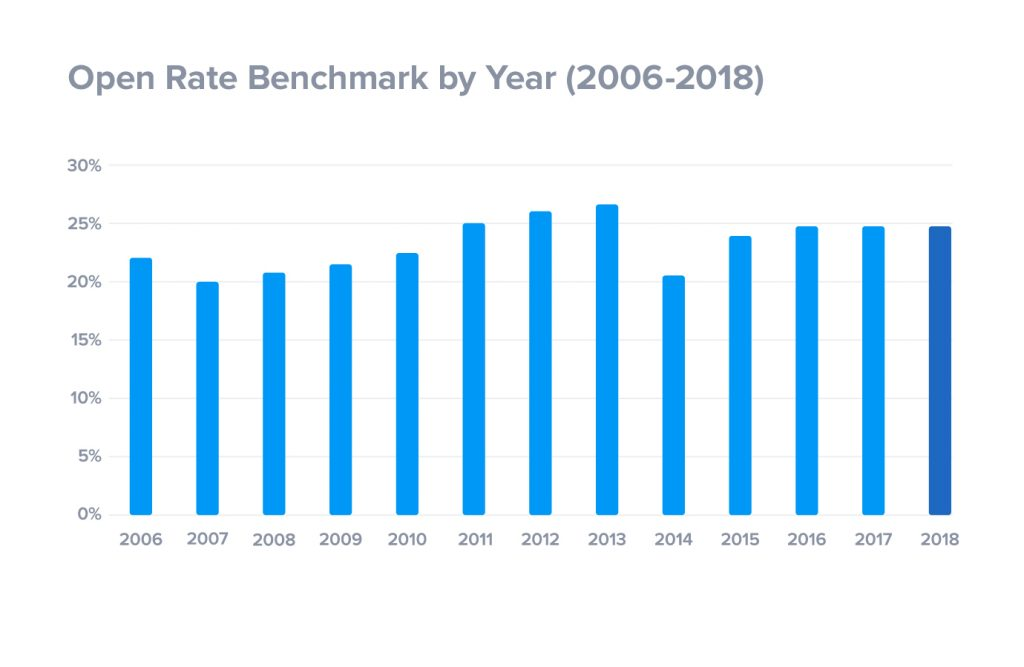
A fact that might surprise you: open rates aren’t in a state of steady, ceaseless decline. In fact,according to Super Office, the average rate has generally been increasing (or at least remaining steady) year-to-year over the past decade-plus:Meanwhile, a newEmail Usage Studyfrom Adobe finds that the average person spends 5+ hours per day checking email, including 3+ hours at work. As Adobe’sSarah Kennedyputs it in ablog post: “The Adobe survey findings solidify how important email still is in the everyday lives of our customers, and this means there is still a big opportunity for marketers to utilize email to engage with people in relevant and useful ways.”Relevant and useful. Therein lies the key. Here’s how we can pursue these ideals.
Refine Your Mailing List
First of all, opt-ins are essential. If you can’t verify that a person on your list actively volunteered to receive emails from you, remove them. You might even want to consider a double-opt-in (send a confirmation email once a person signs up). It’s better to write for 10 people who truly want to receive your messages than 100 who are ambivalent or worse.From there, any type of segmentation you can do will help. Can you divvy up your list based on areas of interest or specialization? If so, you’ll be able to create different content (or even slight variations of the same content) oriented more toward the specific individuals receiving it. A little personalization goes a long way. [bctt tweet="It’s better to write for 10 people who truly want to receive your messages than 100 who are ambivalent or worse. @NickNelsonMN #EmailMarketing" username="toprank"]
Use Email to Build Relationships, Not to Sell
There are multiple problems with salesy emails. One: people generally don’t like them. Two: spam filters tend to be triggered by the terminology used in these messages. Three: they represent a fumbled opportunity.When someone opts into your newsletter and then starts getting overtly pitched right away, it can feel like a betrayal of trust. As a relatively direct and personal form of marketing communication, email should be used to deliver value and build brand affinity. This is not to say you must avoid any type of lead generation elements in your messages, but make them subtle and sparse. [bctt tweet="When someone opts into your newsletter and then starts getting overtly pitched right away, it can feel like a betrayal of trust. @NickNelsonMN #EmailMarketing" username="toprank"]
Speak as a Human, to a Human
Your emails should never come from an address that looks like this: noreply@company.com. Use a real person’s name in the sender field (an executive or marketing manager or whomever you want to use as the face of your outward brand communications) and craft content in a way that feels human and friendly. Ann Handley, Chief Content Officer at MarketingProfs, has an awesome newsletter called TotalAnnarchy that epitomizes this genuine vibe. At Social Media Marketing World earlier this year, she gave a talk aboutcreating a newsletter people want to read. Among her tips: focus less on the NEWS and more on the LETTER, make it delightful, and write as if your message were only going out to one person.I love the way Ann frames the present value of this channel as a marketing tool: Email is the only place where people, not algorithms, are in control. [bctt tweet="Email, when it's done well, is like hot fire. It can burn like nobody's business. Ann Handley @MarketingProfs #EmailMarketing" username="toprank"]
Make Your Emails Visually Interesting
This is tricky terrain because different email clients will display images differently (and sometimes not at all) but in general it’s wise to err on the side of making your emails more colorful and lively. Among their examples ofpowerful B2B marketing campaigns, Campaign Monitor shares thiswebinar promo email from AdWeekfeaturing an animated GIF to infuse their content with understated movement. (Example via Campaign Monitor)Just like on social feeds, compelling visuals can make your emails stand out in a crowded inbox. But make sure you don’t cross the line into gaudiness.
Make Email a Thoughtful Part of Your Overall Strategy
“We need more traffic to our blog post. Do an email blast.” This kind of reactionary thinking is a problematic aspect of email marketing. As we say repeatedly,promotion should be built into campaigns from the start, and every channel should have a distinct purpose. Connect your email strategy with your goals and give it the proper effort to become a worthwhile standalone piece rather than an obligatory add-on.
Bring Your Email Marketing Strategy Back to Life
The rumors of email marketing’s death are greatly exaggerated. This channel can still be a key fixture in your content strategy if you give it the care and attention it deserves. But like other content channels, in order to maximize its efficacy we need to emphasize quality over quantity, focus on building trust-driven relationships, strike a human resonance, spice up the visuals, and connect it to our larger goals and strategy.When you achieve this, you just may reignite that “You’ve got mail!” spark of wonder that recipients feel when your messages pop up in their inbox.Email marketing isn't the only form of promotion that may be missing from your strategy. Learn how to cure what's been called "invisible content syndrome."
By now, you’ve probably heard something about Zola. If you haven’t, suffice to say that they’re kind of a big deal in the wedding industry.
After exploding onto the scene in 2013, Zola quickly became the fastest-growing wedding startup in the United States, trouncing old-school competitors with their headache-free approach to big-day planning. Zola lets couples manage the whole process in one online space, offering thousands of products from hundreds of brands and providing a ton of flexibility. You can register for everything from a cookware set to a sailing tour, exchange luxury wants for practical needs, and postpone shipping until you’ve settled into your proverbial nest together.
Over the past six years, Zola has continued to expand its full suite of wedding planning tools. The goal? Drive traffic by becoming a one-stop-shop for the newly engaged. It’s worked like a hot damn, too. Today, Zola is well on its way to a unicorn valuation as one of the top ecommerce marketplaces in the world.
But the three-tiered cake of Zola’s tremendous growth has a secret filling. What you probably haven’t heard is how the brand’s marketers helped drive customer acquisition like mad by persuasively communicating Zola’s benefits to the diverse segments of its target audience.
How Can Ecommerce Marketers Get More Sales Through Targeted Messaging?
Meet Ari Gayer and Shivanie Barapatre, core members of the customer acquisition crew at Zola. In just over a year, they (along with the rest of Zola’s marketing team) managed to:
Build and launch 300+ custom landing pages for Zola’s specific audience segments.
Optimize their paid search and social campaigns (specifically Google and Facebook) using targeted messaging.
Improve their conversion rates on advertising traffic by anywhere from 5% to 20% over website pages.
As soon as we heard Zola’s wild acquisition story, we knew we needed the whole picture—so we rang up Ari and Shivanie at the company’s headquarters in NYC to get the details.
The Challenge: Get More Couples Registered on Zola Using Google & Facebook Ads
Ari, who’s been at Zola for three years and is now Head of Acquisition, played a key role in the company’s quick success. Since 2016, he’s been responsible for driving traffic to Zola’s ecommerce property and getting new customers into the ecosystem—and as with all fast-growth startups, there’s an urgency to keep the momentum going.
Part of the challenge has always been that Zola’s audience is pretty unique in ecomm. Couples sign up for planning tools anywhere from several months to a few years ahead of their actual wedding (which is when Zola makes bank). This means the brand’s target customers have varying levels of familiarity with the wedding planning process: some just need to hear what makes Zola special, while others still need to be sold on the specific tool they’re looking for. And by continuing to add new functionality to the platform, Zola has been broadening its use cases while further segmenting its audience.
Increasing the number of soon-to-be-weds on the platform was priority number one for Ari and his team (including Shivanie, who came aboard in 2018), and together they implemented a robust paid search and social strategy. But it’s one thing to get traffic, and a whole ‘nother thing to convert traffic.
It didn’t take long for the Zola marketing crew to recognize that the diversity of its audience (in knowledge and intent) meant that sending all of its traffic to one place (like the Zola homepage) wasn’t the best way to get couples registered. Instead, they started experimenting with how they could deliver a relevant and compelling pitch to each of their segments—and that meant landing pages.
A lot of the work [was] about improving the conversion rate of users once they actually land[ed] on the page. And so, managing search, a lot of that—by extension—ends up being landing page testing.
Ari, Shivanie, and the squad had dabbled with using landing pages to target people who were looking for a specific planning tool, or who were at a particular stage of the signup process. Early returns showed that landing pages had the potential to help them get more lovebirds registered than they could through their website alone.
This Facebook ad’s target audience is people interested in creating a wedding website—an awesome opportunity to get them into the Zola ecosystem.
The corresponding landing page highlights Zola’s free website templates, using it as an entry point to the broader planning toolkit.
The problem was that Zola’s marketers were coding pages the ol’ fashioned way and using a third-party optimization tool to test. They didn’t have a method to launch pages as quickly as they wanted and it slowed down their execution.
We were doing smaller-scale things, like changing a hero image, changing button copy or button color, stuff like that. But we wanted to build completely new landing pages. Something much larger scale, and with the potential to have a much higher impact.
Ari knew that landing pages could play a bigger role in their signup journey, becoming an important first-touch and better communicating the benefits of Zola—especially for people who were unfamiliar with the platform.
It’s helpful to have a precursor to a product page that introduces you to the Zola universe—what we offer, what we provide, what the benefits are. It allows us to give a great first impression of who we are and what we bring to the table before having visitors just jump into the product.
Someone who lands directly on Zola’s storefront probably isn’t going to understand the full benefits of the platform.
That’s where landing pages can help.
If they were really gonna crank customer acquisition into overdrive, Zola’s marketing department needed a way to speak convincingly to each of their individual audience segments. To do that, they’d have to find a quicker, easier way to launch landing pages on their own.
The Solution: Build Landing Pages with Targeted Messaging for Different Audience Segments
Enter Unbounce. With a full-fledged landing page platform in their arsenal, Ari and Shivanie were suddenly able to:
Build and launch custom landing pages wayyy faster—without any help from developers.
Deliver persuasive messaging to each of their different audience segments, depending on things like search intent, engagement status, gender, device, and more.
Ari points to Zola’s recent collaboration around wedding invitations with Draper James, a clothing line founded by Reese Witherspoon, as an example of how the Unbounce builder made his team more independent.
We needed a landing page because we knew that the press would cover the collaboration, we knew that we were going to send emails about it, we knew we were going to send paid traffic to it. But all of the engineering resources were occupied with the other parts of the collaboration. So we used Unbounce.
With Unbounce, Ari and his team dragged-and-dropped together a landing page celebrating the partnership in no time—and it looks incredible.
If the Zola x Draper James invites look half as good as this landing page, then sign us up.
Now that they’re able to create landing pages faster, Zola’s marketing team has learned way more about their audience intent—and how to shape their messaging to increase the chance of conversion.
For example, Ari and Shivanie recognized they could adjust their landing page content for different search queries that reflect how far along a visitor is in the buying process. Core terms like “wedding registry” and “wedding website” indicate someone who knows exactly what they want, in which case Zola is better off making a direct pitch around specific benefits and pricing structure.
This landing page targets people who are already searching for a registry, and it’s all about hammering home Zola’s value props.
But as Shivanie points out, more exploratory search terms like “best wedding registry ideas” often require softer messaging.
When we see people searching for a much longer-tailed term, then we know to tailor our messaging [on the landing page] to have a lot more information about what a registry is before introducing Zola’s registry and explaining how it compares to others.
[We’ll present] a lot more educational information upfront, because we know we’re climbing a steeper hill to get this person to convert.
Compare the last page with this one, which targets search terms used by grooms-to-be who are still in an exploratory phase of the planning process.
Zola’s acquisition team has also learned lots about optimizing for visitors consuming content on different devices. Today, almost every landing page Zola creates come in both a desktop and mobile version.
Based on our Unbounce testing, we realized that there are different intents for people who are coming to our pages on desktop versus mobile. What Unbounce has really helped us do is create different experiences for those devices.
For example, being able to have more clear, concise messaging on mobile—with less text and visuals—is going to convert better.
The desktop version of a landing page promoting the benefits of Zola’s wedding registry.
The mobile version of that same landing page. Note the trimmed copy and rearranged sections.
The Results: 300+ Active Landing Pages & 5-20% More Conversions
Since starting to use Unbounce, Ari and his team have created well over 300 landing pages. That’s almost one landing page for every day they’ve been on the platform. (Quite a change from waiting around for developers, huh?)
These pages are each designed to speak to a specific kind of prospect: someone using Pinterest on desktop that wants to build a wedding website, or a not-yet-engaged couple interested in taking a quiz to learn how their preferred home decor style could shape their registry. (Yeah, it gets that specific.)
After the quiz determines the type of decor visitors are interested in, it directs them to products of that style on the Zola store.
The number of new landing pages that we’re launching has grown exponentially. Unbounce has allowed us to tailor those pages to who the audience is, to have much more coherent advertisements—between the ad, the landing page, and the whole experience.
Being able to launch new pages fast means that Ari and Shivanie can always be optimizing to figure out what resonates best with their audience. (ABO, people.) Getting super precise in their targeted messaging has helped Zola turn more of their paid Google and Facebook traffic into new signups.
We’ve measured an increase in conversion rate. It varies from the different landing pages that we’ve launched (since we’ve launched so many), but it’s an increase of 5% to 20% in conversion rate over the website pages we were using beforehand.
Wanna drag-and-drop your way to a higher conversion rate? Find out how Unbounce helps digital retailers and ecomm merchants boost their number of online sales.
That’s not all. Ari and Shivanie’s landing page experiments have been so successful, they’re carrying through their learnings to shape the structure of Zola’s homepage.
We took the highest-converting landing page we had and saw that the specific image, the hero copy, the order of sections were converting very well. So we picked up that page, built it out a little bit more in terms of copy, and applied the same structure to our main homepage.
Here’s Zola’s website homepage alongside one of its most visited landing pages—but which is which?
Deliver Crazy-Specific Messaging & Drive More Sales with Landing Pages
Ari and Shivanie had the daunting task of continuing to expand the customer base of an ecommerce darling already growing at breakneck speed. With the ability to quickly build landing pages that address the specific intent or knowledge gap of a target customer, they managed to refine their paid search and social campaigns and deliver a sizeable uptick in conversions. Not bad for just over a year of work.
The takeaway? Relying on developers to execute your marketing is incompatible with growth. To get the same kind of results as Ari and Shivanie, you need to be able to learn about your audience fast and optimize your digital marketing faster. You need to be able to speak compellingly to your different audience segments in a way that makes clear why your product is a great fit for them.
The Oracle Marketing Cloud Consulting team reads lots of emails. Like, tens of thousands every year. That’s because it’s our job to help brands succeed in the inbox and we’re always looking around for inspiring examples and fresh approaches.
In that spirit, we’re thrilled to share 20 of our favorite emails from the past year as part of our2019 Email Design Look Book—just as we’ve been doing since we released our first Email Design Look Book in 2009. On their own, these emails are fantastic examples of email design, development, copywriting, and cross-channel orchestration. However, together, this collection highlights the six Pillars of Modern Email Design:
1. Minimalism
Email subscribers are hurried and distracted (just like we are), so having a concise and focused message is essential to success. Our 2019 Email Design Look Book includes great examples of minimalism from Bose, Mint, and others.
2. Rich Content
Great animation or video is worth a gazillion words, and intuitive interactivity breaks down the barriers to taking action. Our 2019 Look Book includes great examples of rich content from the BBC, LEGO, Nest, Shutterstock, and others.
3. Authenticity
Take this to heart: Consumers want to engage with brands that share their values and participate in meaningful conversations. Our 2019 Look Book includes great examples of authenticity from Filson, Lou & Grey, Patagonia, REI, and others.
4. Context
Brands must deliver the right content to the right person at the right time. How? Personalization and automation, for starters. Our 2019 Email Design Look Book includes great examples of contextuality from Alaska Airlines, Fandango, Grammarly, Unsplash, and others.
5. Service
Email subscribers want help, advice, and insights that bring greater meaning and satisfaction to a brand’s products and services. Our 2019 Look Book includes great examples of service-mindedness from Etsy, Quip, Simple, and others.
6. Delight
Who doesn’t love a pleasant surprise? (Don’t you dare raise your hand.) Humor, beautiful images, a clever spin on a familiar topic—they’re all gold. Our 2019 Look Book includes great examples of delightfulness from Comcast, Harry’s, Seamless, and others.
We hope you find as much inspiration from these emails as we have—and that they spur you to greater creativity and innovation in your future campaigns.
Need help with your email design?Oracle Marketing Cloud Consulting has more than 500 of the leading marketing minds ready to help you to achieve more with the leading marketing cloud, including creative, coding, automation, and other specialists.