Monday, November 4, 2019

How B2B Marketers Can Build Their Personal Brands on Social Media

For some marketers, it’s second nature. For others, it’s uncomfortable territory. But no matter your predisposition, there’s no denying that personal brand-building is an essential skill in today’s B2B marketing environment.  It’s also fun! Cultivating your social media brand offers an opportunity to tie your own interests, passions, and perspectives into your professional identity.  Let’s explore why this is such an important focus for modern marketing practitioners, how to get it right, and how business leaders can encourage it.

Why Your Personal Brand on Social Media Matters as a Marketer

The list could go on endlessly, but at a high level, the rationale for personal brand-building on social media boils down to three key factors.

#1 - Customers connect with other people more than companies.

As much as we B2B marketers might like to believe otherwise, buyers aren’t drawn to brands. If a rapport is developed, it’s because of the people who represent those companies and build genuine human relationships.  An engaging and relatable personal brand creates a conduit for inbound interest. You don’t need to be overtly promotional. Simply talking about your industry — sharing your views and opinions — can prompt people to reach out and learn more, or to click through to your company’s pages out of interest. These are subtle triggers that generate awareness in an authentic way.  [bctt tweet="An engaging and relatable personal brand creates a conduit for inbound interest for your business. @NickNelson #B2BMarketing #B2BSocialMedia #Branding" username="toprank"]

#2 - Personal profiles get more organic reach than brand pages.

This is true of virtually all social networks. The underlying motivation of any social media company is to keep users on their sites, engaging with others. Because of the dynamic we just mentioned — humans are more drawn to other humans than faceless brands — these networks are apt to elevate content from personal accounts over organizational ones. If you’ve ever done any social media marketing, you’ve likely noticed how difficult it is to grow the reach of company content on platforms like Facebook and LinkedIn without paying to amplify it.  Personal profiles offer a workaround. Creating content that aligns with your company’s narrative — or even simply re-sharing posts from the brand page via your own profile — increases the visibility of this content. Not only that, but it puts a real face on the source of the information. Here's a simple example from our own Lane Ellis. Example of Sharing Your Company's Post to Your Own Social Profile

#3 - Your career growth and success might depend on it.

Yes, growing your personal brand on social media can help your company. But more than anything, it’s a valuable focus for you. When someone wants to research you online, they are very likely to check out your social accounts first and foremost. The researcher could be a customer, who will be impressed by an active and knowledgeable presence, but also a potential employer, for whom the same will be true. Not only does an investment in growing your personal brand yield benefits for your marketability, but also for your professional network and even your capabilities. Through this undertaking, you’re bound to learn things you can apply in your job — even if the primary themes of your personal brand don’t exactly align with what your company does (more on that shortly).

How to Effectively Build Your Personal Brand on Social Media

It’s a paradox: many B2B marketers are incredibly gifted at portraying and promoting the brands they represent, but entirely uncomfortable or unfamiliar with doing the same for themselves. If that’s you, here are some tips to strengthen your results.

Find Your Rhythm

Being active on social media doesn’t mean you need to post something every hour, or even every day. It’s about finding a consistent routine that works for you and your followers. To more efficiently post content on multiple networks, or schedule batches of posts at once, take advantage of a tool like Hootsuite, Sprout, or Buffer. 

You Don’t Have to Talk About the Same Things Your Company Does

This is a misconception that seems to hold people back. Maybe you’re not all that personally interested in what your company does, or you drain yourself by talking about it all day at work. One idea is to find a particular angle of your business or industry that strikes a chord with you, and will resonate with others. For instance, if you work in the finance industry, you could make data privacy your main area of exploration. Or, you could choose to build your personal brand around something that doesn’t overlap with your company and its services. There’s benefit in growing your own audience and engagement even if it’s not the exact same audience your company serves. As one example, take my story. I started blogging about baseball long before I was an agency marketer. In 2012 I teamed up with three others to create a website called Twins Daily. My Twitter presence is mostly oriented around baseball and that community. But through this experience I’ve learned many things that make me a better marketer. I’ve broadened my platform and reach. And I’ve grown my personal network, connecting with plenty of other marketers, creatives, and brand folks who also happen to be baseball fans. Find your distinct passion and connect it to your professional identity. Just make sure the passion comes first.

Create a Balanced Approach

Maintaining a steady pipeline of interesting stories and commentary to share on your personal account is easier said than done. When it comes to refining your social media mix, SAP’s* Head of Global Influencer Marketing Ursula Ringham shared some sage wisdom with our Caitlin Burgess in her Digital Marketing Spotlight interview. Ursula situates her social output around her “five truths”: 
  1. My work
  2. My family
  3. My passion
  4. Sports
  5. Third-party voices
This is a good framework. Define a similar mix that aligns with your passion/professional sweet spot, and use these truths as pillars for your content strategy. [bctt tweet="The bottom line here is: Be authentic. Be yourself (or your brand). But be strategic. — @ursularingham" username="toprank"]

Stand Out and Be Fascinating

“Don’t underrate your ability to fascinate,” urged NYT best-selling author Sally Hogshead in her interview with Lee Odden on personal branding for marketers back in 2015. “In a sense, most of us were schooled to avoid being too fascinating. As kindergartners we’re taught to stand in line for class. Color within the lines. Raise a hand. Wait your turn. Standing out is labeled as misbehaving.” [bctt tweet="You will not win by being invisible. Today, you win by being seen and remembered. Stand out, or don’t bother. — @SallyHogshead" username="toprank"] Sally's insights are just as relevant today. Just as companies need to differentiate themselves and rise above the saturated market, you’ll want to do the same with your personal brand in a social media world populated by billions of other people. Use your marketing brain to understand what will get noticed and drive engagement — catchy headlines, provocative angles, trendy topics, bold imagery, etc. 

How B2B Companies Can Support Personal Brand-Building from Employees

If you’re a CMO or another business leader who sees the value in personal brand-building for employees, but you’re struggling to promote the practice within your ranks, here are a few ideas to get things moving. 
  • Implement an Employee Advocacy Program: Whether using a dedicated platform (LinkedIn Elevate* is among the most popular) or a more informal system run by people within your company, an employee advocacy program generates a pipeline of brand-approved content or articles that people in your company can easily access and share through their own networks. This is helpful because it removes the common reluctance among employees about getting in trouble for sharing or saying the wrong things. It can also make it easier for non-marketers to get on board.
  • Lead by Example: When executives use their personal networks to dispense thought leadership and speak on behalf of the brand, it’s powerful. And when employees see this behavior, it can provide them with encouragement and a model to follow. 
  • Make It Inviting and Natural: The problem with many corporate-driven advocacy initiatives? “It’s so nakedly promotional, it’s like a commercial,” Jay Baer opines in a B2B Spotlight interview on the convergence of customer experience and employee advocacy. “Nobody’s gonna put that on their personal social media. They’re trying to turn employees into shills and nobody’s down with that.” For guidance on steering clear of this pitfall, I highly recommend watching the portion of Jay and Lee’s conversation that starts around the 9-minute mark in this video:
To learn more about personal brand-building and how it can align with a company’s marketing goals, check out Caitlin’s post on How Employee Engagement Helps Drive the Success of Your Marketing Efforts. *Disclosure: LinkedIn and SAP are TopRank Marketing clients.

The post How B2B Marketers Can Build Their Personal Brands on Social Media appeared first on Online Marketing Blog - TopRank®.


from Online Marketing Blog – TopRank® https://ift.tt/2NfwSEO
via IFTTT

How to Personalize Emails at Scale — While Sticking to Your Brand's Creative Rules

The more brands a retailer works with, the more complex sets of rules they have to navigate in the design of their marketing assets. This is particularly true for luxury retailers, who work with brands that have spent decades building up elite reputations — and maintain correspondingly strict rules about where, when and how their names can be used.

Say, for example, that a luxury retailer sells items by Gucci, Louis Vuitton, Prada, Burberry and Tory Burch. Imagine (hypothetically) that Prada won’t allow the retailer to show their products next to Louis Vuitton in any marketing email — while Gucci won’t allow their products to be featured next to any sale creative.

Rules like these make it impossible for a retailer to personalize an email for every one of the millions of subscribers on their list, while adhering to every brand’s rules across every variation. Just designing one single set of emails within these intricate constraints — let alone an entire email campaign — would consume hundreds of hours of manual work.

This is precisely where automated email campaign personalization demonstrates its value. Machine learning personalization software is not only smart enough to learn complex sets of pre-specified rules — it adheres to those rules even as it learns from real-world customer interactions, and uses that data to guide each subscriber on their own personalized journey through the product space. Here’s how.

Treat Each Individual Asset as Its Own Separate Piece of Creative

Email marketers at many retail brands have a tendency to think of entire emails as pre-designed creative assets. This line of thinking runs especially strongly at luxury retailers, whose strictly cultivated aesthetic standards date all the way back to the days of full-page advertisements in magazines and newspapers.

Once a retailer enters the realm of individualized email personalization, however, the inherent limitations of this approach quickly become obvious. Even if the retailer automates an entire campaign, their “pre-baked” creatives prevent their software from reaching each customer with the messaging and visuals most likely to generate a click-through.

At the same time, many retailers are reluctant to hand over full control of personalization to their automation software, for fear of inadvertently sending “Franken-emails” filled with nonsensical combinations of creative and messaging. As a result, their marketing teams may spend days or even weeks manually combing through emails, triple-checking that every creative and message is aligned with the brand’s voice and values.

Thankfully, a third approach solves both these challenges. In this “middle way,” retailers treat each asset — whether it’s a sale banner, a new arrivals message, or a lifestyle shot — as its own piece of creative. Their designers shape the creative’s visuals and messaging in alignment with the brand’s look and feel, then hand it over to the marketing team, who instruct their machine-learning software how the asset can be combined with others.

Label Each Creative Asset with Tags that Specify How and Where It Can Be Used in an Email

Just as pre-designed creative assets enable a brand to maintain full aesthetic control while achieving personalization at scale, guardrail rules ensure that every asset is used only in the right locations and combinations within each email.

One easy way of setting guardrail rules is to label each creative asset with tags. These tags may specify that a given asset can never appear in the same email as certain other creatives — for example, that ads for Gucci purses may be shown with Prada ads, but not with Louis Vuitton. Alternately, a tag may specify that certain creatives must always appear together — for example, that every email advertising summer swimwear must also contain ads for sandals.

Tags can also be used to specify how long each creative is allowed to remain active — preventing spring dresses from appearing in emails sent as autumn approaches, for example — as well as which subject lines and messaging can (and can’t) be used in emails containing each creative. In all these ways, guardrail rules neatly avoid the problem of the “Franken-email,” by setting specific parameters within which the software can generate email variations.

Use Machine Learning and Automation to Personalize Content Within Those Guardrail Rules

By setting guardrail rules around pre-designed creative assets, brands remain firmly in the driver’s seat of personalization. At the same time, this approach frees automation software to learn from each interaction with every customer, and responsively tailor that pre-vetted messaging in ways that create magical moments of engagement at scale.

Along the way, this approach vastly streamlines the personalization process, freeing designers to concentrate on developing innovative new assets, while freeing marketers to concentrate on the high-level strategies of their campaigns.

In all these ways, the combination of pre-vetted creatives, guardrail rules, and intelligent automation results in campaigns that delight customers — while precisely adhering to the boundaries specified by every brand in a retailer’s product catalog.


Part of personalizing emails is knowing if your audience prefers to read them on a mobile device. Find out “5 Pro Tips for Optimizing Email for Mobile.”

See the infographic


from Oracle Blogs | Oracle Marketing Cloud https://ift.tt/34q5w4A
via IFTTT

Sunday, November 3, 2019

Focus on the Letter Portion of Email Newsletter


On the Fly is our new video series with small bites (two mins or less) of marketing advice and training from marketing experts, delivered while they are on the road, at the airport, or traveling somewhere. 

This week’s episode features Ann Handley, modern marketing guru and the Chief Content Officer of Marketing Profs. Every two weeks, Ann sends out a newsletter with writing tips and fresh marketing ideas you don’t want to miss. As someone who has a very successful newletter, Ann’s advice to us is, “focus less on the news and more on the letter”. 

According to research from MarketingProfs and the content marketing institute, 87% of marketers are using email newsletter as a way to  distribute their content- or focusing on the the “news” part of the newsletter. However, very few are leveraging newsletters as an opportunity to directly connect with their consumer. Focusing on the “letter” part of the newsletter will change the way we communicate to our customers. 


Watch full video:


Visit OnTheFly.Experts to see all episodes. 


Check out our Do More with Email Deliverability and Privacy guide and learn how to maximize the potential number of emails that reach your target inboxes. 


from Oracle Blogs | Oracle Marketing Cloud https://ift.tt/2oFZj5k
via IFTTT

Saturday, November 2, 2019

Weekend Favs November 2

Weekend Favs November 2 written by John Jantsch read more at Duct Tape Marketing

My weekend blog post routine includes posting links to a handful of tools or great content I ran across during the week.

I don’t go into depth about the finds, but encourage you to check them out if they sound interesting. The photo in the post is a favorite for the week from an online source or one that I took out there on the road.

  • Adtrackr – Receive notifications when your competitors launch Facebook ads.
  • Font Pairings by People – Get suggestions of fonts that work well together.
  • Clearbrain – Discover the customer behavior that causes them to take a specific action.

These are my weekend favs, I would love to hear about some of yours – Tweet me @ducttape


from Duct Tape Marketing https://ift.tt/2r4klvf
via IFTTT

Friday, November 1, 2019

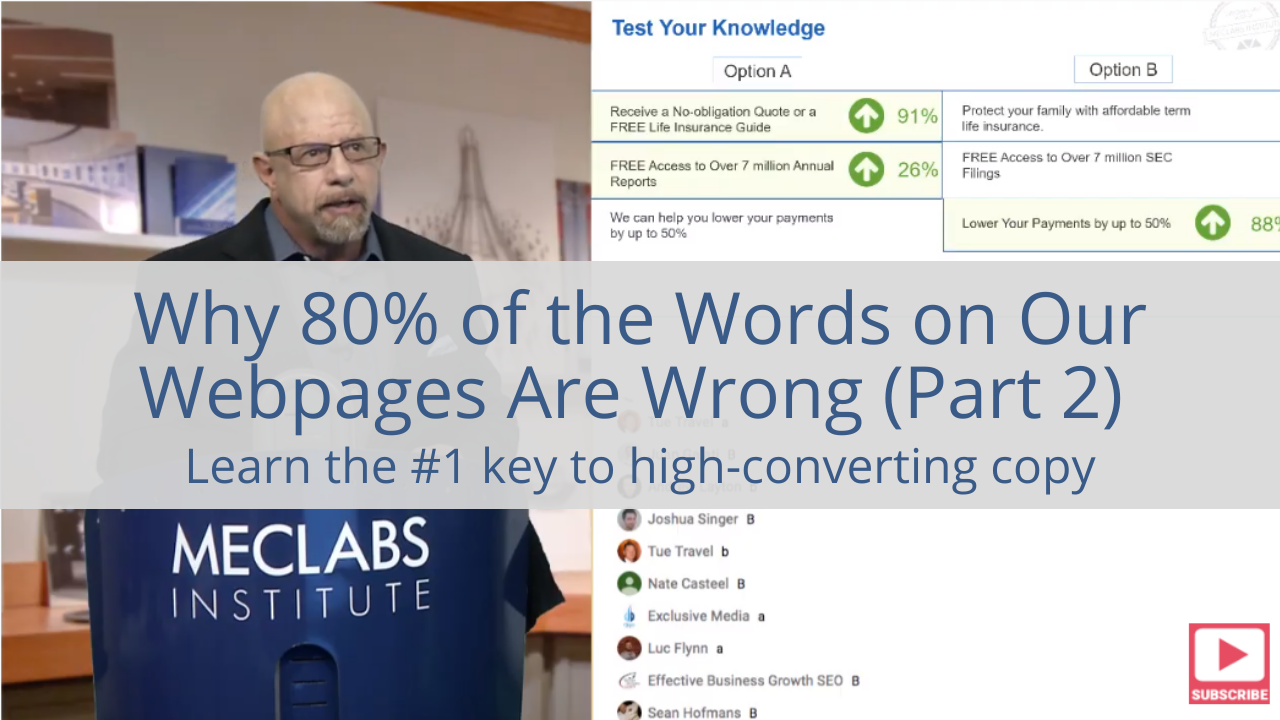
Why 80% of the Words on Our Webpages Are Wrong: Learn the #1 key to high-converting copy (Part 2)

This article was originally published in the MarketingExperiments email newsletter

In Part 2 of our series on high-converting copy, Flint McGlaughlin shares six common but deadly mistakes copywriters make on webpages. He gives strategies to correct those errors and teaches viewers how to ease the customer through organic friction in the buy process.

Watch this replay of a YouTube live interactive session to learn a step-by-step evaluation process you should apply to your copy before hitting the “publish” button.

(You can view part 1 here.)

Here are some key points in the video:

  • 1:17 Our video producer’s puppy visits the studio
  • 7:48 Transparent Marketing – you can access the free PDF here: https://marketingexperiments.com/valu…
  • 14:13 Several headlines optimized showing quantitative conversion results
  • 23:26 Live optimization – HR website
  • 27:00 Don’t use impersonal language with stacked prepositions and modifiers
  • 32:00 Don’t use an untrustworthy tone
  • 34:18 Don’t have a me-centric structure
  • 37:54 A list of the 6 deadly copywriting errors
  • 42:20 Don’t use qualitative modifiers (use quantitative)
  • 48:20 Don’t make vague claims
  • 50:29 Don’t neglect using transitional words
  • 56:51 How to evaluate copy step-by-step for maximum effectiveness

Related Resources

Email Messaging Online Certification Course – Optimize email messaging and copywriting to achieve maximum clickthrough

Copywriting: 3 tips for optimizing your next direct mail campaign

Email Copywriting: How a change in tone increased lead inquiry by 349%

Why 80% of the Words on Our Webpages Are Wrong: Learn the #1 key to high-converting copy (Part 1)

The post Why 80% of the Words on Our Webpages Are Wrong: Learn the #1 key to high-converting copy (Part 2) appeared first on MarketingExperiments.


from MarketingExperiments https://ift.tt/34qLbw9
via IFTTT

Facebook to limit number of ads Pages can run simultaneously

The change is expected to impact a small percentage of advertisers, starting mid-2020.

Please visit Marketing Land for the full article.


from Marketing Land - Internet Marketing News, Strategies & Tips https://ift.tt/33k1udK
via IFTTT

Is it wise to rob CX to pay for growth?

The lack of attention to user needs will eventually manifest as a bottom-up revolt and when those users become decision-makers, it will negatively impact the business.

Please visit Marketing Land for the full article.


from Marketing Land - Internet Marketing News, Strategies & Tips https://ift.tt/2PEh1RG
via IFTTT